

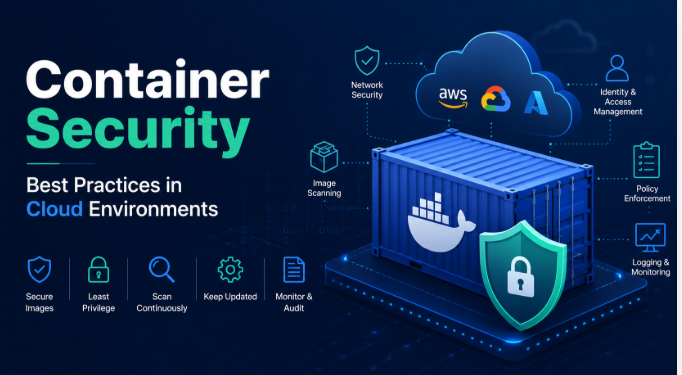
Container technology has transformed how modern applications are developed, deployed, and managed in cloud environments. Platforms such as Docker and Kubernetes enable organizations to build scalable, portable, and efficient applications. However, containers also introduce unique security challenges that require careful planning and continuous monitoring.
Implementing strong container security practices helps protect applications, sensitive data, and cloud infrastructure from cyber threats while ensuring compliance with industry standards.
What Is Container Security?
Container security is the practice of protecting containerized applications throughout their entire lifecycle—from development and deployment to runtime and maintenance.
It includes securing container images, orchestrators, cloud infrastructure, networks, and application workloads.
Use Trusted Container Images
Always build containers from trusted and verified base images obtained from reputable sources.

Organizations should:
- Use official images whenever possible.
- Remove unnecessary packages.
- Keep images lightweight.
- Regularly update base images.
Trusted images reduce the risk of introducing vulnerabilities.
Scan Images for Vulnerabilities
Container images should be scanned before deployment to identify known security flaws.
Automated vulnerability scanning helps detect:
- Outdated software.
- Security misconfigurations.
- Known CVEs (Common Vulnerabilities and Exposures).
- Weak dependencies.
Continuous scanning ensures newly discovered vulnerabilities are identified promptly.
Apply the Principle of Least Privilege
Containers should operate with only the permissions they need.
Avoid:
- Running containers as the root user.
- Granting unnecessary Linux capabilities.
- Providing unrestricted access to host resources.
Limiting privileges reduces the impact of potential attacks.
Secure Kubernetes Clusters
For organizations using Kubernetes, cluster security is essential.
Best practices include:
- Enable role-based access control (RBAC).
- Protect the Kubernetes API server.
- Restrict administrative access.
- Encrypt sensitive data.
- Regularly update Kubernetes versions.
Strong cluster security helps prevent unauthorized access.
Protect Secrets and Credentials
Never store passwords, API keys, or certificates directly inside container images.
Instead, use secure secret management solutions provided by cloud platforms or dedicated secret management tools.
Proper credential management minimizes the risk of accidental exposure.
Implement Network Security
Container communication should be carefully controlled.
Network security measures include:
- Network segmentation.
- Firewall rules.
- Kubernetes network policies.
- Encrypted communication using TLS.
- Restricted inbound and outbound traffic.
These controls help limit lateral movement during security incidents.
Monitor Runtime Activity
Runtime monitoring helps detect suspicious behaviour after containers are deployed.
Security teams should monitor:
- Unexpected processes.
- Unusual network connections.
- Privilege escalation attempts.
- Resource usage anomalies.
- Unauthorized file changes.
Real-time monitoring improves threat detection and response.
Keep Software Updated
Regularly patch operating systems, container runtimes, orchestration platforms, and application dependencies.
Timely updates reduce exposure to newly discovered vulnerabilities and improve overall security.
Implement Continuous Security Testing
Security should be integrated throughout the development lifecycle.
Organizations should include:
- Automated security testing.
- Infrastructure-as-Code validation.
- Configuration reviews.
- Compliance checks.
- Penetration testing.
Continuous security helps identify issues before production deployment.
Common Container Security Challenges
Despite their advantages, containerized environments present several security challenges.
These include:
- Misconfigured cloud resources.
- Insecure container images.
- Poor access control.
- Secret management failures.
- Supply chain attacks.
- Limited runtime visibility.
Addressing these risks requires ongoing governance and security monitoring.
The Future of Container Security
As cloud-native technologies continue to evolve, container security is becoming increasingly automated. Artificial intelligence, behavioural analytics, zero-trust architectures, and policy-as-code solutions are improving threat detection and compliance.
Organizations are also adopting DevSecOps practices to integrate security into every stage of software development and deployment.
Conclusion
Container security is a critical component of modern cloud computing. By using trusted images, scanning for vulnerabilities, applying least-privilege access, securing Kubernetes clusters, protecting secrets, and continuously monitoring workloads, organizations can significantly reduce security risks.
A proactive security strategy combined with regular updates and automated testing enables businesses to confidently deploy scalable, resilient, and secure cloud-native applications.
Frequently Asked Questions (FAQs)
1. What is container security?
Container security involves protecting containerized applications, images, infrastructure, and orchestration platforms throughout their lifecycle.
2. Why is container security important?
It helps prevent cyberattacks, protects sensitive data, maintains application availability, and supports regulatory compliance.
3. What is a container image?
A container image is a packaged file that includes an application, its dependencies, libraries, and runtime environment needed to run consistently across systems.
4. Why should container images be scanned?
Scanning identifies known vulnerabilities, outdated software, insecure configurations, and dependency risks before deployment.
5. What is the principle of least privilege?
It means granting users, applications, and containers only the minimum permissions required to perform their intended tasks.
6. How can secrets be protected in containers?
Use dedicated secret management services or cloud-native secret stores instead of embedding passwords, API keys, or certificates inside container images.
7. Why is Kubernetes security important?
Kubernetes manages large numbers of containers, so securing its clusters, API access, and permissions helps protect the entire application environment.
8. What is runtime security?
Runtime security involves monitoring containers after deployment to detect suspicious activities, policy violations, or attempted attacks.
9. How often should container images be updated?
Container images should be updated regularly whenever security patches, dependency updates, or new stable releases become available.
10. What is the future of container security?
The future includes AI-assisted threat detection, zero-trust security models, automated compliance checks, policy-as-code, and deeper integration of security into DevSecOps workflows.