

Serverless architecture has become one of the most popular cloud computing models for building modern, scalable applications. Instead of managing physical servers or virtual machines, developers focus on writing code while cloud providers automatically handle infrastructure, scaling, maintenance, and availability.
This approach allows businesses to build applications faster, reduce operational complexity, and pay only for the computing resources they actually use.
What Is Serverless Architecture?
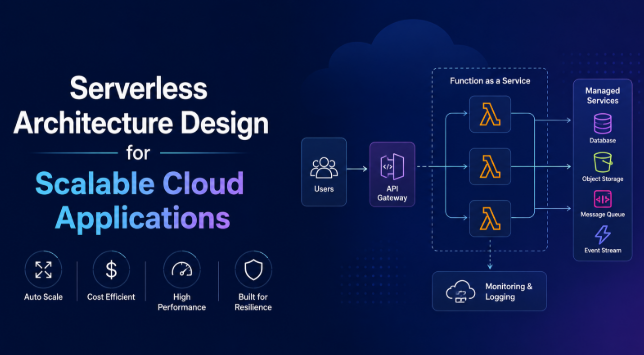
Serverless architecture is a cloud computing model where the cloud provider manages the underlying infrastructure. Developers deploy functions or services that run in response to events without provisioning or maintaining servers.
Popular serverless services support automatic scaling based on application demand.
Benefits of Serverless Computing
Serverless platforms offer several advantages for businesses and development teams.
- Automatic scaling.
- Lower infrastructure management.
- Faster application deployment.
- Pay-as-you-use pricing.
- High availability.
These benefits help organizations focus more on innovation than infrastructure maintenance.
Event-Driven Architecture
Serverless applications are commonly built using event-driven design.
Events such as:
- User requests.
- File uploads.
- Database updates.
- Payment confirmations.
- API calls.
can automatically trigger serverless functions to perform specific tasks.
Microservices Integration
Serverless architecture works well with microservices, where applications are divided into small, independent services.
Each service can be developed, deployed, and updated independently, improving flexibility and simplifying maintenance.
API Management
Most serverless applications expose functionality through APIs.
API gateways help:
- Route incoming requests.
- Authenticate users.
- Manage traffic.
- Apply security policies.
- Monitor API performance.
This creates secure and reliable communication between users and cloud services.
Data Storage Strategies
Serverless applications often use managed cloud databases and object storage services.
Selecting the right storage solution depends on application requirements such as performance, scalability, consistency, and cost.
Managed databases reduce administrative work while supporting automatic scaling.
Security Best Practices
Security remains essential in serverless environments.
Recommended practices include:
- Apply least-privilege access.
- Encrypt sensitive data.
- Enable multi-factor authentication.
- Secure API endpoints.
- Monitor logs continuously.
Regular security reviews help protect applications from evolving threats.
Monitoring and Performance
Observability is critical for serverless applications.
Organizations should monitor:
- Function execution time.
- Error rates.
- API response times.
- Resource usage.
- Application logs.
Continuous monitoring helps identify issues early and improve user experience.
Common Challenges
Although serverless offers many benefits, businesses should also consider challenges such as:
- Cold-start latency for some workloads.
- Vendor-specific features that can increase migration effort.
- Execution time limits.
- Complex distributed debugging.
- Cost management for high-volume applications.
Proper architecture planning helps reduce these limitations.
The Future of Serverless Computing
Serverless technology continues to evolve with improvements in artificial intelligence, edge computing, container support, and developer tooling. Future platforms are expected to provide faster startup times, stronger security, enhanced observability, and broader support for distributed applications.
As cloud adoption grows, serverless architecture will remain an important option for building modern, scalable, and cost-efficient applications.
Conclusion
Serverless architecture enables organizations to develop scalable cloud applications without managing traditional server infrastructure. With automatic scaling, event-driven processing, managed services, and pay-as-you-use pricing, businesses can deliver applications more efficiently while reducing operational overhead.
By following best practices for security, monitoring, API management, and application design, organizations can successfully build reliable serverless solutions that support long-term business growth.
Frequently Asked Questions (FAQs)
1. What is serverless architecture?
Serverless architecture is a cloud computing model where the cloud provider manages the infrastructure, allowing developers to focus on writing and deploying application code.
2. Does serverless mean there are no servers?
No. Servers still exist, but they are managed by the cloud provider rather than the application developer.
3. What are the main benefits of serverless computing?
Key benefits include automatic scaling, reduced infrastructure management, faster development, high availability, and pay-for-use pricing.
4. What types of applications are suitable for serverless architecture?
Serverless is commonly used for web applications, APIs, event-driven systems, data processing, mobile backends, and IoT applications.
5. How does serverless scaling work?
The cloud platform automatically allocates or removes computing resources based on incoming demand, without manual intervention.
6. What is an event-driven application?
An event-driven application responds to specific events, such as user actions, file uploads, or database updates, by triggering automated functions.
7. Is serverless architecture secure?
It can be highly secure when organizations implement strong identity management, encryption, secure APIs, regular monitoring, and least-privilege access controls.
8. What are the limitations of serverless computing?
Potential limitations include cold starts, execution time limits, debugging complexity, and dependence on provider-specific services.
9. How do businesses monitor serverless applications?
They use cloud monitoring tools to track execution times, errors, logs, API performance, resource usage, and overall application health.
10. What is the future of serverless architecture?
The future includes deeper integration with AI, edge computing, improved performance, enhanced security, better developer tools, and wider adoption for scalable cloud-native applications.