

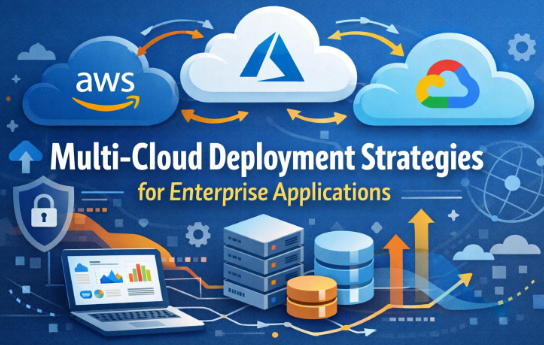
As businesses accelerate their digital transformation, many enterprises are adopting multi-cloud strategies to improve flexibility, resilience, and performance. Instead of relying on a single cloud provider, organizations distribute applications and workloads across multiple cloud platforms. This approach helps reduce vendor dependence, improve disaster recovery, and optimize costs while allowing businesses to take advantage of the unique services offered by different cloud providers.
A well-planned multi-cloud deployment strategy enables enterprises to build scalable, secure, and highly available applications for modern business needs.
What Is Multi-Cloud Deployment?
Multi-cloud deployment is the practice of using cloud services from two or more public or private cloud providers. Applications, databases, and workloads may run across multiple environments depending on business requirements.
Unlike relying on a single provider, multi-cloud offers greater flexibility and reduces operational risks.
Benefits of Multi-Cloud Strategies
A multi-cloud approach provides several advantages for enterprise applications.
- Reduces vendor lock-in.
- Improves application availability.
- Enhances disaster recovery.
- Optimizes cloud costs.
- Supports global scalability.
These benefits help businesses remain competitive in rapidly changing markets.
Choosing the Right Workloads
Not every application needs to run across multiple clouds. Organizations should identify workloads that benefit most from improved availability, geographic distribution, or specialized cloud services.
Critical business applications often receive the highest priority for multi-cloud deployment.
Design for Portability
Applications should be designed to run consistently across different cloud environments.
Using containers, Kubernetes, and standardized APIs allows workloads to move more easily between cloud providers while reducing migration complexity.
Implement Strong Security
Security remains one of the most important aspects of multi-cloud deployment.
Best practices include:
- Encrypt sensitive data.
- Enable multi-factor authentication.
- Apply identity and access management.
- Monitor cloud activity continuously.
- Perform regular security assessments.
Consistent security policies should be applied across every cloud platform.
Centralized Monitoring
Managing multiple cloud environments requires unified monitoring tools.
Centralized dashboards help IT teams monitor system health, application performance, resource utilization, and security events from a single interface.
Real-time visibility improves operational efficiency.
Optimize Cost Management
Multi-cloud environments can become expensive without proper oversight.
Businesses should regularly review resource usage, remove unused services, automate scaling, and monitor cloud spending to improve cost efficiency.
Financial visibility helps prevent unnecessary expenses.
Plan for Disaster Recovery
One of the biggest advantages of multi-cloud deployment is improved resilience.
By distributing applications and data across multiple cloud providers, businesses can continue operations if one platform experiences an outage.
Regular backup testing ensures recovery plans remain effective.
Address Common Challenges
Although multi-cloud offers many benefits, organizations may encounter challenges such as:
- Increased operational complexity.
- Data synchronization.
- Security consistency.
- Compliance management.
- Skills and training requirements.
A clear governance strategy helps address these issues.
The Future of Multi-Cloud
As cloud technologies continue to evolve, multi-cloud environments will become increasingly automated through artificial intelligence, infrastructure as code, and advanced orchestration platforms.
Future enterprise applications are expected to rely on intelligent workload placement, automated security, and real-time resource optimization across multiple cloud providers.
Conclusion
Multi-cloud deployment has become an important strategy for enterprises seeking greater flexibility, reliability, and scalability. By carefully selecting workloads, implementing strong security practices, designing portable applications, and monitoring cloud resources effectively, organizations can maximize the benefits of multiple cloud environments.
As businesses continue to expand globally, multi-cloud strategies will play a vital role in supporting resilient, secure, and high-performing enterprise applications.
Frequently Asked Questions (FAQs)
1. What is a multi-cloud strategy?
A multi-cloud strategy involves using services from two or more cloud providers to host applications and workloads.
2. Why do enterprises use multiple cloud providers?
They use multiple providers to improve reliability, reduce vendor lock-in, optimize costs, and access specialized cloud services.
3. What is the difference between multi-cloud and hybrid cloud?
Multi-cloud uses multiple cloud providers, while hybrid cloud combines private infrastructure with one or more public cloud environments.
4. How does Kubernetes support multi-cloud deployments?
Kubernetes helps manage containerized applications consistently across different cloud platforms, making deployment and scaling easier.
5. Is multi-cloud more secure than a single cloud?
Multi-cloud can improve resilience, but security depends on proper configuration, consistent policies, monitoring, and access controls across all environments.
6. What are the biggest challenges of multi-cloud deployment?
Common challenges include operational complexity, cost management, security consistency, compliance, and integrating data across providers.
7. Which applications benefit most from multi-cloud?
Mission-critical applications, globally distributed services, disaster recovery systems, and workloads requiring high availability often benefit the most.
8. How can businesses reduce multi-cloud costs?
They can monitor usage, automate scaling, remove unused resources, optimize workloads, and regularly review cloud spending.
9. Why is centralized monitoring important?
It provides a unified view of performance, availability, security events, and resource usage across all cloud environments, helping teams respond quickly to issues.
10. What is the future of multi-cloud deployment?
The future includes greater automation, AI-driven workload optimization, stronger security, improved interoperability, and more efficient management tools that simplify operating across multiple cloud platforms.