

Introduction
Fitness equipment has evolved considerably over the years. Traditional exercise machines have gradually been improved with more convenient controls, compact designs, adjustable settings, and features intended to make workouts more comfortable. Treadmills are a good example of this development.
What was once a relatively straightforward running machine is now available in numerous designs, ranging from slim walking pads to larger models with multiple workout programmes and adjustable inclines. Although these developments provide buyers with more choices, they can also make the purchasing process confusing.
Understanding the technology behind a treadmill helps people distinguish genuinely useful features from specifications they may never need. Rather than selecting a machine simply because it has the most functions, buyers should consider how each feature contributes to their intended exercise routine.
The Motor: An Important Part of Treadmill Performance
The motor is one of the central components of an electric treadmill. It powers the running belt and helps maintain movement at the selected speed.
Motor specifications are therefore worth examining before purchasing equipment. However, buyers should avoid comparing machines using a single number without understanding what it represents.
Manufacturers may provide different motor ratings, including continuous horsepower and peak horsepower. Continuous ratings generally provide a more useful indication of sustained performance than temporary peak figures.
The appropriate motor depends on several factors, including the user’s weight, intended exercise intensity, frequency of use, and treadmill design.
A walking-focused machine may have different requirements from equipment intended for regular running. People who expect to use a treadmill for extended periods should pay particular attention to the manufacturer’s recommended usage and motor information.
It is also worth reviewing warranty coverage for the motor because this component can be important when evaluating the long-term value of a machine.
Speed Controls and Their Practical Applications
Speed adjustment is another essential feature. It allows users to select an exercise intensity that matches their ability and training objectives.
For beginners, lower speeds provide an opportunity to become familiar with the machine. Comfortable walking can be introduced before gradually increasing the pace.
More experienced users may prefer higher speeds for jogging or running sessions.
Different treadmill categories offer different speed ranges. Walking pads generally prioritise slower movement, whereas traditional treadmills provide greater flexibility for running.
For example, Sportconic’s S7 walking pad offers speeds of up to 6 km/h. The P106FA Pro and T140 reach up to 12 km/h, while the T155 provides a maximum speed of 14 km/h.
These differences demonstrate why it is important to identify the intended use before comparing products.
A machine with a higher maximum speed is not necessarily a better choice for someone who only plans to walk. Similarly, regular runners should ensure that their selected equipment can comfortably support their preferred training pace.
Understanding Incline Technology
Incline functionality introduces another dimension to treadmill workouts.
When a running surface is raised, walking or running requires a different level of effort compared with exercising on a flat belt. This provides an opportunity to introduce variety without changing the equipment or workout location.
Some machines offer manual incline adjustment, while others provide preset levels.
The Sportconic P106FA Pro features an incline of up to 9%. Its T140 model offers three incline settings of 2%, 4%, and 6%, while the T155 provides additional incline options.
Incline settings can be useful for people who want to make walking sessions more challenging. They also allow users to experiment with different workout structures.
For instance, a session could begin with several minutes of flat walking, followed by a short incline interval and a recovery period.
Beginners should start with a comfortable setting and increase the difficulty gradually. The correct approach depends on individual fitness, balance, and physical capabilities.
Running Belt Dimensions and Construction
A treadmill’s running surface has a direct influence on the available space for movement.
People sometimes focus heavily on maximum speed while overlooking the dimensions of the belt. However, a comfortable running surface is particularly important for individuals with longer strides or those who regularly perform faster workouts.
A narrow belt may be adequate for walking but less comfortable for running. A longer surface can provide additional room for forward movement.
The dimensions of some Sportconic models illustrate these differences:
- S7: 95 × 40 cm.
- P106FA Pro: 105 × 40 cm.
- T140: 110 × 41 cm.
- T155: 120 × 42 cm.
When comparing these measurements, consider your height, stride length, exercise style, and available floor space.
The construction of the running belt also matters. Follow the manufacturer’s guidance regarding lubrication, alignment, cleaning, and replacement to maintain proper operation.
Digital Displays and Workout Programmes
Many modern treadmills include digital displays that provide information during exercise.
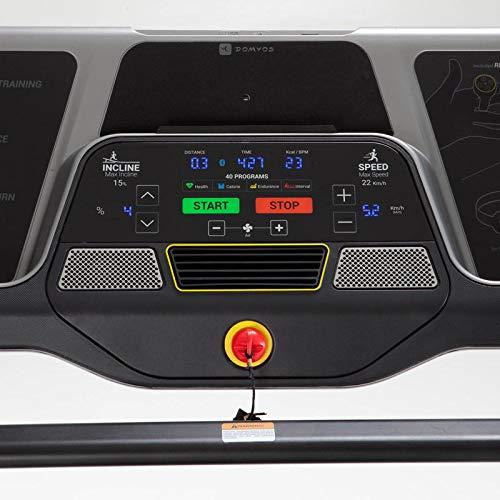
Depending on the model, these screens may show speed, elapsed time, distance, and estimated calories. Such information helps users understand the basic details of each workout.
Some models also offer preset programmes. These can provide a structured alternative to manually adjusting speed throughout a session.
Sportconic’s T140 and T155 models include twelve workout programmes. This gives users additional options when they want to vary their sessions.
However, more programmes do not automatically produce better training results. A simple display with easy-to-understand controls may be more useful for someone who prefers straightforward walking sessions.
Buyers should also check how clearly the display can be viewed during exercise and whether the controls are conveniently positioned.
Remote Controls and Everyday Convenience
Small design details can make a noticeable difference in everyday equipment use.
Walking pads often use remote controls to adjust speed without requiring users to reach towards a traditional console. This can be especially convenient for individuals using a walking pad during light desk work.
Some conventional treadmills offer control buttons positioned near the handrails, making adjustments easier during exercise.
When comparing machines, consider whether the control system is intuitive and whether essential functions can be accessed quickly.
A straightforward interface is particularly valuable for beginners who may not want to spend time learning complicated operating procedures.
Folding Mechanisms and Space-Saving Designs
Not every home has a dedicated fitness room. For this reason, the ability to fold and store exercise equipment has become an important consideration.
Walking pads are generally designed with compact storage in mind. Traditional folding treadmills may offer a larger running surface while allowing the main structure to be raised when the equipment is not being used.
Sportconic provides several designs for different household requirements.
The S7 has a compact, flat structure, while the P106FA Pro features a folding design with a relatively low folded height. The T140 and T155 also offer folding arrangements intended to make storage more convenient.
Before selecting a model, compare its dimensions in both operating and folded positions.
Check whether the machine has transport wheels and whether the intended storage location provides enough clearance.
A folding treadmill should also be opened and secured according to the manufacturer’s instructions before every workout.
Safety Features and User Protection
Safety should never be overlooked when purchasing exercise equipment.
A treadmill should provide a stable platform, accessible controls, and appropriate support for its intended use.
Handrails can be particularly useful for people who prefer additional support while walking. Safety keys or emergency-stop mechanisms are also important features to understand before operating a machine.
Users should become familiar with the controls before beginning their first workout. Starting at a low speed and increasing it gradually is a sensible way to become comfortable with the equipment.
The surrounding area should remain clear of obstacles, cables, furniture, and other objects that could interfere with movement.
Children and pets should be kept away from an operating treadmill. Equipment should be switched off and secured when not in use.
Following the manufacturer’s safety guidance helps create a more controlled workout environment.
How to Compare Models Before Purchasing
People planning to loopband kopen should compare complete specifications instead of relying exclusively on advertised discounts or promotional descriptions.
A useful comparison should include:
Maximum speed: Determine whether the machine supports walking, jogging, or running at the required pace.
Motor specifications: Examine the continuous and peak ratings where available, alongside recommended usage.
Running surface: Check whether the dimensions are appropriate for your height and stride.
Incline functionality: Decide whether adjustable elevation is important for your preferred workouts.
Display and programmes: Consider whether additional tracking information or preset sessions would actually be useful.
Storage dimensions: Ensure the treadmill fits comfortably within your home.
Warranty and support: Review the manufacturer’s terms, maintenance requirements, and customer service arrangements.
Sportconic’s loopband voor thuis collection provides a starting point for comparing different treadmill formats and specifications.
Taking time to examine these factors makes it easier to select equipment according to practical requirements rather than marketing claims.
Maintenance and Long-Term Performance
Even well-designed equipment requires regular care.
A treadmill should be cleaned according to the manufacturer’s instructions, particularly around the running belt and areas where dust can accumulate.
Belt tension and alignment should be checked periodically. Lubrication should only be performed using the recommended products and procedures.
Users should also avoid overloading the machine or operating it beyond its intended limits.
If the treadmill begins producing unusual noises, displaying errors, or operating inconsistently, stop using it and consult the manufacturer’s troubleshooting guidance or customer support.
Regular maintenance can help identify minor issues before they become more significant problems.
Conclusion
Modern treadmills offer a wide range of technologies and design features, but understanding their practical purpose is more important than choosing the model with the longest specification list.
Motor performance, speed controls, incline settings, running surface dimensions, digital displays, folding mechanisms, and safety systems all contribute to the overall experience.
The ideal machine depends on the user’s exercise habits, available space, and long-term expectations.
By comparing these features carefully, buyers can make a more informed decision and choose equipment that supports their preferred training style. A suitable treadmill can become a practical part of a home fitness environment, providing opportunities for regular indoor activity throughout the year.