


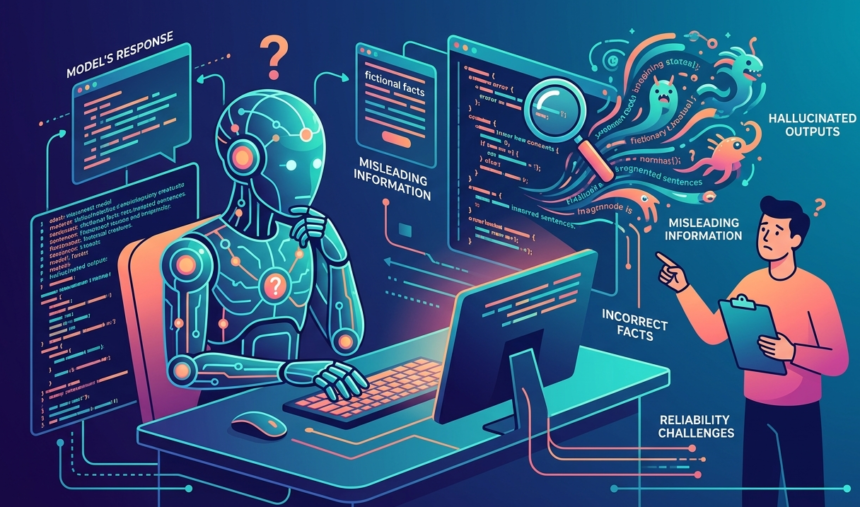
Large Language Models (LLMs) have transformed the way people interact with artificial intelligence. They can answer questions, write articles, generate code, summarize documents, and assist with countless professional and personal tasks. Despite these impressive capabilities, LLMs are not perfect. One of their most significant limitations is the phenomenon known as AI hallucination.
In the context of artificial intelligence, a hallucination occurs when a language model generates information that sounds convincing but is inaccurate, fabricated, or unsupported by reliable evidence. Understanding why hallucinations occur and how to minimize them is essential for businesses, developers, researchers, and everyday users who rely on AI tools.
What Is an AI Hallucination?
An AI hallucination is a response generated by a language model that contains false, misleading, or invented information presented as if it were factual.
Hallucinations can include fabricated statistics, incorrect dates, imaginary references, nonexistent research papers, inaccurate code, or made-up quotations. In many cases, the response appears fluent and confident, making the errors difficult to detect without verification.
Why Do Large Language Models Hallucinate?
Large Language Models are designed to predict the most likely sequence of words based on patterns learned during training. They do not possess human understanding or verify facts in the way people do.
More Read

Several factors contribute to hallucinations, including:
- Incomplete or ambiguous prompts
- Limited or outdated training data
- Lack of real-time information
- Conflicting information in training data
- Statistical prediction rather than factual reasoning
These factors can cause models to generate plausible but incorrect responses.
Common Types of Hallucinations
Hallucinations can appear in different forms depending on the task.
More Read
Fabricated Facts
The model may invent historical events, scientific findings, or technical details that have no factual basis.
Fake Citations
LLMs sometimes generate references, research papers, authors, or web links that do not actually exist.
Incorrect Reasoning
A response may contain logical errors or flawed conclusions even when individual facts appear reasonable.
Invented Code
Programming examples may include nonexistent functions, incorrect syntax, or unsupported software libraries.
False Confidence
One of the biggest challenges is that hallucinated responses are often presented with the same confidence as accurate information.
Why Hallucinations Matter
Hallucinations can have significant consequences depending on how AI is used.
More Read
In education, they may spread misinformation. In healthcare, legal services, or finance, inaccurate information could contribute to poor decisions if not carefully reviewed. Businesses using AI for customer support or content creation also need safeguards to maintain accuracy and trust.
Because of these risks, human oversight remains essential for important tasks.
Industries Most Affected
Many sectors benefit from LLMs while also facing risks related to hallucinations.
Common examples include:
- Healthcare
- Legal services
- Financial services
- Software development
- Education
- Journalism
- Customer support
In these industries, AI outputs should be reviewed by qualified professionals before being relied upon.
How Developers Reduce Hallucinations
Researchers and developers continue improving LLM reliability through various techniques.
These include better training methods, reinforcement learning, retrieval-augmented generation (RAG), improved prompt engineering, model fine-tuning, and fact-checking systems that connect AI models with trusted information sources.
While these approaches reduce hallucinations, they do not eliminate them completely.
How Users Can Minimize Hallucinations
Users also play an important role in improving AI accuracy.
Helpful practices include:
- Ask clear and specific questions.
- Request sources when appropriate.
- Verify important facts independently.
- Break complex questions into smaller parts.
- Use trusted references for critical decisions.
- Treat AI as an assistant rather than a final authority.
These habits help reduce the likelihood of relying on incorrect information.
The Role of Human Oversight
Human expertise remains one of the best defenses against AI hallucinations.
Professionals can evaluate context, verify claims, identify inconsistencies, and apply critical thinking that AI cannot fully replicate. Human review is especially important for medical advice, legal guidance, financial planning, scientific research, and safety-critical applications.
AI works best when it supports—not replaces—human judgment.
Future Improvements
Research into more reliable AI models continues at a rapid pace.
Future advancements may include stronger reasoning capabilities, improved factual grounding, better integration with trusted databases, enhanced transparency, and more effective uncertainty detection. These improvements aim to make AI systems more dependable across a wide range of applications.
Even with future advances, occasional errors are likely to remain a challenge that requires careful oversight.
Best Practices for Organizations
Businesses adopting LLMs should establish responsible AI practices.
- Verify AI-generated information before publication.
- Keep humans involved in important decisions.
- Train employees on AI limitations.
- Use trusted data sources when possible.
- Monitor AI performance regularly.
- Develop policies for responsible AI use.
Responsible governance helps organizations maximize AI’s benefits while reducing risks.
Conclusion
Large Language Models have revolutionized communication, automation, and knowledge work, but they are not infallible. AI hallucinations occur because these systems generate responses based on learned language patterns rather than true understanding or guaranteed factual accuracy.
By recognizing the causes of hallucinations, verifying important information, and maintaining appropriate human oversight, individuals and organizations can use LLMs more effectively and responsibly. As AI research continues to advance, future models are expected to become more reliable, but critical thinking and fact-checking will remain essential.
Frequently Asked Questions (FAQs)
1. What is an AI hallucination?
An AI hallucination is when a language model generates information that is incorrect, fabricated, or unsupported while presenting it as though it were accurate.
2. Why do Large Language Models hallucinate?
LLMs generate responses by predicting likely word sequences rather than verifying facts. Ambiguous prompts, limited information, and statistical prediction can all contribute to hallucinations.
3. Can AI hallucinations be completely eliminated?
No. Current techniques can significantly reduce hallucinations, but they cannot eliminate them entirely.
4. Which industries are most affected by AI hallucinations?
Healthcare, law, finance, education, journalism, software development, and customer service are among the industries where inaccurate AI outputs can have significant consequences.
5. How can users reduce the risk of hallucinations?
Use clear prompts, verify important information with reliable sources, request supporting evidence when appropriate, and rely on human expertise for critical decisions.
6. Will future AI models stop hallucinating?
Future models are expected to become more accurate through improved reasoning, better access to reliable information, and stronger validation methods, but human oversight and fact-checking will continue to be important.