

Artificial Intelligence Applications in Autonomous Transportation Systems

admin
By admin
19 Min Read

Introduction to Autonomous Transportation Systems

Autonomous transportation systems represent a transformative evolution in the field of mobility, leveraging advanced technologies to operate vehicles with minimal or no human intervention. These systems are designed to enhance safety, efficiency, and convenience in transportation, thus redefining traditional modes of travel. At the core of these systems is the integration of various technologies, including sensors, data processing units, and artificial intelligence (AI).

The key concept behind autonomous transportation systems revolves around the idea of automating the driving process. Vehicles are equipped with sophisticated hardware and software that enable real-time processing of environmental data. This allows for the identification of obstacles, navigation of routes, and adherence to traffic regulations without the need for human input. Such capabilities are crucial in addressing the challenges posed by urban congestion and the rising demand for efficient public transport.

The motivation behind the development of these systems stems from the growing need for safer, more efficient transportation options. According to research, human error accounts for approximately 94% of traffic accidents. By employing autonomous vehicles, there is significant potential to reduce the incidence of accidents, thus saving lives and reducing healthcare costs associated with road traffic injuries.

Moreover, the environmental implications of autonomous transportation are noteworthy. With the ability to optimize driving patterns and improve traffic flow, these systems can contribute to reduced emissions and enhanced fuel efficiency. These factors underscore the significance of autonomous systems in the current context, as they align with global goals for sustainability and smarter urban planning.

As we delve deeper into the applications of artificial intelligence and its role in shaping autonomous transportation systems, it is essential to recognize how this integration not only drives innovation but also holds the potential to revolutionize our everyday travel experiences.

The Role of Artificial Intelligence in Autonomous Navigation

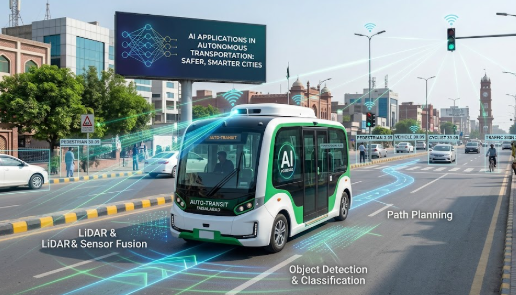
Artificial Intelligence (AI) plays a pivotal role in the navigation systems of autonomous vehicles. By integrating advanced algorithms, these systems execute complex tasks such as perceiving the environment, analyzing data in real-time, and making informed decisions crucial for safe transit. Among the primary technologies utilized in autonomous navigation, computer vision stands out for its ability to process and understand images from the vehicle’s cameras. Through techniques such as object recognition and segmentation, AI systems can identify other vehicles, pedestrians, and obstacles, allowing for precise navigation.

Furthermore, sensor fusion is essential in enhancing the reliability of these autonomous systems. This technology integrates data from various sensors, including LiDAR, radar, and ultrasonic sensors, to create a comprehensive understanding of the vehicle’s immediate surroundings. By merging information from multiple sources, autonomous systems can achieve a more accurate representation of the driving environment, proving critical for operational safety and efficiency. For instance, sensor fusion enables the vehicle to filter out noise and erroneous data, resulting in better detection of surrounding objects, which is vital for making driving adjustments.

Machine learning techniques also contribute significantly to autonomous navigation. These techniques enable vehicles to learn from past experiences, adapting their behaviors based on environmental changes and new patterns. By employing supervised learning and reinforcement learning methods, AI algorithms can refine their decision-making processes, leading to improved navigation capabilities. This dynamic learning approach allows autonomous vehicles to better cope with diverse and unpredictable driving scenarios, ensuring that they can navigate safely and effectively.

AI-Powered Decision Making in Traffic Management

The advent of artificial intelligence (AI) has significantly transformed traffic management systems by enhancing decision-making capabilities through comprehensive data analysis. AI technologies harness real-time data from various sources such as traffic cameras, sensors, and GPS devices to create a dynamic traffic management environment. By integrating these data streams, AI can analyze current traffic conditions in real-time, enabling effective responses to fluctuating traffic demands.

One essential aspect of AI in traffic management is predictive modeling. Through machine learning algorithms, systems can interpret historical and real-time data to foresee traffic patterns and potential congestion points. For instance, utilizing algorithms trained on traffic volume and accident data allows traffic management systems to forecast peak travel times, enabling preemptive measures such as adjusting traffic light durations or deploying traffic enforcement resources. This predictive capability not only alleviates congestion but also enhances overall road safety.

Furthermore, AI enhances traffic flow optimization by implementing adaptive traffic control systems. These systems utilize data within a closed-loop framework to improve real-time signal timings and traffic routing. By continuously learning from traffic conditions, AI-driven traffic management systems can dynamically adjust signals and routes based on current demand, leading to improved travel times and reduced emissions. In addition, AI contributes to the identification of hazardous conditions, allowing for prompt interventions aimed at minimizing risks to public safety.

In conclusion, AI-driven decision-making plays a vital role in modern traffic management systems. Through real-time data analysis and predictive modeling, AI is not only optimizing traffic flow but also improving safety on our roads, leading to more efficient transportation systems and a better quality of life for commuters.

Safety Enhancements Through AI Algorithms

Artificial Intelligence has become a cornerstone in enhancing safety within autonomous transportation systems. As these vehicles navigate dynamic environments, AI algorithms play a crucial role in mitigating risks and improving overall reliability. One of the key safety features enabled by AI is obstacle detection. Using various sensors, cameras, and LiDAR systems, AI can accurately identify and classify objects around the vehicle. This capability allows autonomous systems to respond swiftly to potential hazards, which is critical for preventing collisions and ensuring pedestrian safety.

Additionally, AI-driven emergency braking systems are integral to the safety architecture of autonomous vehicles. These systems rely on real-time data analysis to make immediate decisions, applying brakes only when necessary, and at the right moment, thereby reducing the likelihood of accidents. Such mechanisms are particularly effective in urban environments where unexpected obstacles, such as pedestrians or cyclists, may suddenly appear in the vehicle’s path.

Moreover, continuous learning is a fundamental aspect of AI that significantly enhances safety measures through ongoing data collection and analysis. Autonomous vehicles are equipped with machine learning algorithms that improve their decision-making capabilities over time. By processing vast amounts of driving data from various environments, these algorithms can adapt to new scenarios, identify trends, and refine their predictive accuracy. This process of continuous improvement ensures that autonomous vehicles remain safe and reliable even as they encounter unfamiliar situations.

In conclusion, the integration of AI algorithms into autonomous transportation systems fundamentally enhances safety through advanced obstacle detection, efficient emergency braking systems, and continuous learning. As technology evolves, these systems are expected to become even more reliable, reducing the probability of accidents and ensuring safer travel for all road users.

The Impact of Machine Learning on Vehicle Performance

Machine learning (ML) plays a pivotal role in enhancing the performance of autonomous vehicles by employing adaptive learning techniques that allow these systems to continuously improve over time. By analyzing vast amounts of data collected from various sensors—such as cameras, lidar, and radar—machine learning algorithms can identify patterns and optimize decision-making processes. This capability is vital for enabling vehicles to understand complex driving environments, effectively navigate obstacles, and adapt to changing conditions.

One of the key features of machine learning in these systems is its emphasis on real-time improvements. Vehicles equipped with ML algorithms can process incoming data and make instantaneous adjustments to their performance. For instance, when a self-driving car encounters unexpected road conditions or a sudden stop from a vehicle ahead, its machine learning system can quickly analyze past experiences and input data, allowing it to respond appropriately without human intervention. This ability to learn on-the-fly significantly enhances vehicle safety and operational efficiency.

Moreover, machine learning enhances vehicle performance through continuous evolution based on user data and environmental variables. As autonomous vehicles operate in diverse settings, they generate substantial amounts of data, which can be harnessed to refine ML models. This ongoing learning process enables the system to adapt not only based on user preferences—such as driving style or preferred routes—but also to external factors, including weather conditions and traffic patterns. Consequently, the more data these vehicles accumulate, the smarter they become, ultimately leading to a more reliable and efficient transportation experience.

Through these developments, machine learning serves as a cornerstone of intelligent transportation systems, driving the advancement of vehicle technology and performance to unprecedented levels.

AI in Fleet Management and Logistics

Artificial Intelligence (AI) has substantially transformed fleet management and logistics, particularly within the realm of autonomous transportation systems. Through the utilization of sophisticated algorithms and predictive analytics, AI enhances routing efficiency, ensuring that vehicles take the most optimal paths to their destinations. This not only minimizes travel time but also correlates with reduced fuel consumption and operating costs.

Real-time tracking is another pivotal application of AI in fleet management. By leveraging advanced tracking technologies, operators can monitor the precise location of each vehicle in the fleet. This capability facilitates immediate decision-making, such as re-routing in the event of unforeseen obstacles or traffic congestion, thereby maintaining schedule adherence and customer satisfaction. Such transparency in operations allows logistics managers to maintain a proactive approach to fleet efficiency.

Moreover, predictive maintenance, powered by AI, serves as a significant advancement in extending the longevity of fleet vehicles and preventing operational downtime. AI models can analyze massive datasets generated from vehicle operations to identify patterns and predict potential failures before they occur. By scheduling maintenance only when necessary, fleets can reduce costs associated with unplanned repairs, leading to higher overall efficiency.

In summary, the integration of AI into fleet management and logistics within autonomous transportation systems generates considerable advantages. Enhanced routing, real-time tracking, and predictive maintenance capabilities contribute to streamlined operations, reduced costs, and elevated service quality. As these AI technologies continue to evolve, they pave the way for a more efficient and sustainable future in transportation logistics.

Ethical Considerations and Challenges

The deployment of artificial intelligence in autonomous transportation systems presents several ethical considerations that must be addressed to ensure public trust and safety. One critical aspect involves accountability—specifically, who is responsible when an AI system makes a decision that leads to harm. As vehicles become more autonomous, the question of liability shifts from human drivers to the manufacturers or the software developers of the technology. Determining responsibility in scenarios such as accidents or malfunctions raises complex legal and moral questions that are yet to be clearly defined.

Furthermore, the decision-making processes embedded within these AI systems require rigorous ethical frameworks, especially in life-threatening situations. For instance, if faced with an unavoidable accident scenario, should an autonomous vehicle prioritize the safety of its occupants or minimize overall harm to other road users? The implementation of ethical algorithms in such critical moments remains a significant challenge. This challenge highlights not only the need for sophisticated technology but also the importance of embedding societal values into AI programming.

In addition to accountability and decision-making, the societal implications of widespread adoption of autonomous vehicles cannot be overlooked. While proponents argue that these technologies could enhance safety and reduce traffic congestion, concerns persist regarding the potential displacement of jobs in driving professions and the ethical consequences of normalizing reliance on machines for transportation. As autonomous transportation systems become increasingly prevalent, fostering discussions that involve various stakeholders, including ethicists, technologists, and the broader public, is essential. Engaging in robust dialogues about the ethical frameworks governing AI applications will ultimately contribute to developing autonomous systems that align with societal norms and expectations.

Future Prospects of AI in Autonomous Transportation

The future of artificial intelligence (AI) in autonomous transportation systems is poised for significant evolution, driven by advancements in technology and growing investment within the sector. As AI continues to enhance the capabilities of autonomous vehicles, several emerging trends are likely to shape the trajectory of this industry.

One of the most prominent areas of focus is the integration of deep learning algorithms and machine learning techniques into autonomous transportation systems. These developments will enable vehicles to process vast amounts of data from various sensors and cameras, leading to improved decision-making and navigational accuracy. Consequently, the implementation of AI-driven systems is expected to increase road safety and reduce traffic congestion, major challenges that contemporary transportation networks face.

Moreover, the ongoing advancement of communication technologies such as 5G is anticipated to enhance connectivity among autonomous vehicles, infrastructure, and other road users. Such connectivity will facilitate real-time information sharing, allowing vehicles to communicate with traffic lights and other drivers, thus optimizing routing and vehicle flow. This technology could ultimately contribute to smart city initiatives and promote sustainable urban development.

The anticipated growth of the autonomous transportation industry is further supported by regulatory advancements and increasing consumer acceptance. Governments are beginning to establish frameworks and guidelines that support the testing and deployment of autonomous vehicles. Simultaneously, public interest in AI and autonomous technologies continues to rise, indicating a readiness to embrace innovative transportation solutions.

As AI applications in autonomous transportation systems evolve, they promise to transform society’s interaction with mobility. These advancements hold the potential to redefine urban planning, improve the efficiency of transportation networks, and enhance overall quality of life by promoting safer, more efficient transportation options.

Conclusion

Artificial intelligence has emerged as a pivotal force in revolutionizing autonomous transportation systems. Throughout this blog post, we have examined the various applications of AI in enhancing the safety, efficiency, and reliability of transport mechanisms. From self-driving cars to drones and automated public transport, AI technologies are redefining how we navigate our environments.

The integration of AI in transportation systems not only increases operational efficiency but also significantly reduces human errors, which are often the primary cause of accidents. By leveraging machine learning and data analytics, autonomous vehicles can perceive their surroundings, make informed decisions, and continuously learn from their experiences. This dynamic adaptability is crucial in developing intelligent transport systems that can respond to real-time challenges.

Moreover, the deployment of AI in logistics and route optimization streamlines the movement of goods, leading to economic benefits and energy conservation. As cities grow and population density increases, efficient transport solutions are imperative to maintain urban mobility and reduce congestion. Autonomous vehicles powered by AI are positioned to address these issues effectively.

However, while the potential of AI in autonomous transportation is vast, it is equally important to approach these advancements with responsibility and caution. Continuous research and development must be coupled with ethical considerations, regulatory frameworks, and public engagement to ensure that these technologies are safe and beneficial for society. The upcoming years will be crucial in shaping the future of transport, making it essential to invest in both innovative solutions and the ethical implications of their implementation.

In conclusion, the synergy between artificial intelligence and autonomous transportation systems heralds a new era of mobility. As we navigate this evolving landscape, fostering innovation while prioritizing safety and ethical standards will be essential in realizing the full potential of these groundbreaking technologies.

Share This Article
Leave a comment

Leave a Reply

Your email address will not be published. Required fields are marked *