


Most 3D printing troubleshooting guides are written for dry or temperate climates. In coastal cities such as Chennai, Mumbai, and Kochi, relative humidity regularly crosses 70–80%, and the monsoon pushes it higher. In these conditions, material storage is not a minor detail. It is often the main reason for failed prints.
If your 3D printer was printing perfectly last month and now produces stringy, weak, or bubbly parts, the machine may not be the problem. Your materials may simply have absorbed moisture.
Why Humidity Damages Filament
Most thermoplastics are hygroscopic, meaning they absorb moisture from the air. When wet filament passes through a nozzle at 200–260°C, the trapped water turns to steam. The result:
- Popping or crackling sounds while printing
- Excessive stringing and oozing
- Rough, bubbly, or pitted surfaces
- Weak layer adhesion and brittle parts
- Inconsistent extrusion and under-extrusion
Not every material absorbs moisture at the same rate. PLA is relatively tolerant. PETG and TPU absorb moisture faster, and nylon is extremely sensitive. In humid conditions, nylon can absorb enough moisture to affect print quality within hours of being left out.
How to Store Filament Properly
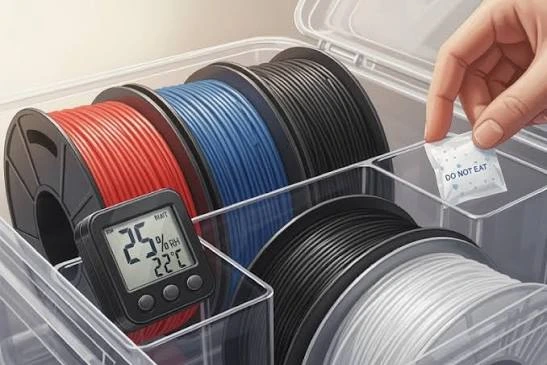
The goal is to keep spools in an environment below roughly 20–30% relative humidity.

- Use airtight containers. Vacuum-seal bags or airtight plastic boxes with rubber gaskets work well. Avoid cardboard boxes, which absorb moisture themselves.
- Add desiccant. Place silica gel packets or loose indicating silica gel, which changes colour when saturated, inside each container. Recharge or replace it regularly. In humid months, this may mean every few weeks.
- Add a cheap hygrometer. A small digital hygrometer inside your storage box shows when the desiccant has stopped working.
- Keep spools sealed until needed. When you buy 3D printer filament, leave it in its factory vacuum packaging until you are ready to print, and keep the original desiccant packet with the spool.
- Print from a dry box for sensitive materials. For long prints with PETG, TPU, or nylon, feed filament directly from a sealed dry box with a PTFE tube outlet. This stops the spool from absorbing moisture during a 10-hour print.
How to Dry Filament That Has Absorbed Moisture
Wet filament can usually be recovered. A dedicated filament dryer is the most reliable option. A food dehydrator or a properly calibrated oven also works, but household ovens often run hotter than the dial shows, so verify the temperature with a thermometer first.
Common starting points:
| Material | Drying temperature | Approximate time |
| PLA | 45–50°C | 4–6 hours |
| PETG | 60–65°C | 4–6 hours |
| TPU | 50–55°C | 4–8 hours |
| ABS | 65–80°C | 4–6 hours |
| Nylon | 70–80°C | 8–12 hours |
Always check the manufacturer’s recommendation. Drying PLA too hot can soften and deform the spool.
Why Resin Needs a Different Approach
Resin does not absorb moisture the way filament does, but it has its own climate-related needs. Photopolymer resin is sensitive to light and temperature.
Light exposure: UV light, including indirect sunlight through a window, can partially cure resin in the bottle or vat. Always store bottles in their original opaque containers, away from windows.
Temperature: Most resins print best around 20–30°C. Warm Indian rooms are usually within that range, but an air-conditioned room set to 18°C can make resin thicker. That leads to failed prints and weak supports. If your printer sits in a cold AC room, consider an enclosure or a small resin heater to keep it at a consistent temperature.
Shelf life: Unopened resin generally lasts around a year when stored correctly. Shake or stir bottles before each use, because pigments and additives settle over time.
When choosing a 3D printer resin, check its recommended operating temperature and exposure settings. Tough, flexible, and high-temperature formulations often have narrower working ranges than standard resin.
Safe Handling Tips for Resin in Small Spaces
Many Indian makers print from home offices or small workshops, so safe handling matters:
- Wear nitrile gloves. Latex does not protect well against resin.
- Ventilate the room, or use an enclosure with a carbon filter.
- Keep resin away from children, pets, and food preparation areas.
- Never pour liquid resin or contaminated IPA down the drain. Cure leftover resin under UV or sunlight before disposing of it as solid waste.
A Simple Monsoon Checklist
Before the rainy season starts, run through this list:
- All open spools stored in airtight containers with fresh desiccant
- Hygrometers in each storage box reading below 30% RH
- A filament dryer or dehydrator available for recovery
- Moisture-sensitive materials (PETG, TPU, nylon) printed from a dry box
- Resin bottles stored away from windows and direct light
- Printer room temperature checked if it is air-conditioned
Final Thoughts
In humid climates, good storage habits make more difference to print quality than most printer upgrades. A few airtight boxes, some silica gel, and a hygrometer cost very little compared with the filament, resin, and print time they save. Treat material storage as part of your printing workflow, not an afterthought, and your results will be far more consistent all year.