


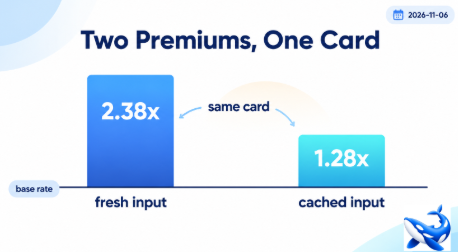
On OrcaRouter one card charges three different premiums depending on the token. A single premium number hides the fact that a card charges differently for different kinds of token. OrcaCyber GLM 5.3 API, one of the three cards released on 2026-11-04, costs $3 in / $5 out / $0.30 cache on OrcaRouter against a base of $1.26 / $3.96 / $0.234 [OURS]. Against that base the input premium is 2.38×, the output premium 1.26×, and the cache premium 1.28×. Three tokens, three very different prices, one card.
The gap between 2.38× and 1.28× is the whole subject here. It decides whether the abliterated card costs roughly twice its base or roughly one and a quarter times, and the deciding variable is not the model — it is how much of your prompt is a repeat of the last one.
Three premiums, computed
| line | base | OrcaCyber | premium |
| fresh input | $1.26 | $3.00 | 2.38× |
| output | $3.96 | $5.00 | 1.26× |
| cached input | $0.234 | $0.300 | 1.28× |
| blended 3:1, all fresh | $1.935 | $3.50 | 1.81× |
The blended row is the one people quote, and it assumes every input token is fresh. That assumption is wrong for most real workloads. A security card is used on artefacts — a repository, a log archive, a build tree — and the same artefact is re-sent across many questions.
Change the mix and the multiple changes with it. A workload where 80% of input is cached has an effective input rate of `0.2 × 3.00 + 0.8 × 0.30 = $0.84` on the abliterated card and `0.2 × 1.26 + 0.8 × 0.234 = $0.439` on the base [OURS]. The input premium drops from 2.38× to 1.91×, and the blended premium from 1.81× to about 1.43×.

What that means for a real investigation
Take a repository audit: 200,000 tokens of source, sent once, then referenced across twenty follow-up questions, each with a 1,500-token prompt and a 3,000-token answer.
Fresh input. The first call pays 200,000 tokens at full rate: $0.60 on the abliterated card, $0.25 on the base.
Repeated input. The twenty follow-ups re-send the same 200,000 tokens. Cached, that is 4 million tokens at $0.30 per million: $1.20 — against $0.94 on the base. If the cache does not hit, the same 4 million tokens cost $12.00 instead of $1.20.
Output. Twenty answers of 3,000 tokens is 60,000 output tokens: $0.30 against $0.24.
Totals: $2.10 on the abliterated card and $1.43 on the base, an effective multiple of 1.47× — well below the headline 1.81× and nowhere near the 2.38× input premium [OURS].
The lesson is not that the premium is small. It is that the premium is a property of the workload as much as of the card, and quoting one number for it is a category error.
Where the cache stops working
Caches match prefixes. A timestamp at the top of the prompt, a case identifier, a randomised tool list — each breaks the match and returns the workload to the 2.38× tier.
On this card that failure is expensive in a specific way. A 200,000-token artefact re-sent without a cache costs $0.60 per request at $3.00 input; re-sent with a cache it costs $0.06. The difference is a factor of ten, and it is entirely a property of prompt construction, not of the model or the price page.
The rule that follows is mechanical: put the artefact first, everything generated after it, and never let a per-request value sit above the stable block. It is worth more on a card with a 2.38× input premium than on one with a 5.33× premium, because the absolute rate — $3.00 — is high enough that every uncached token is visible in the bill.
When the cache ratio decides the purchase
Three workload shapes, three different answers from the same card.
One-shot questions, no repetition. Every input token is fresh, so the premium is the input multiple: 2.38×. A batch of 10,000 one-shot analyses at 5,000 tokens each costs $150.00 on this card against $63.00 on the base [OURS].
Long artefact, many questions. The premium is close to the cache multiple: 1.28×. A 200,000-token repository asked about twenty times costs $2.10 against $1.43 [OURS].
Mixed: a stable block plus fresh context. The premium lands between the two, weighted by the split. This is the commonest shape in practice and the one that no published multiple describes.
The practical instruction is to compute the effective input rate from your own logs — `fresh_rate × 3.00 + cached_share × 0.30` — and compare that number, not the headline pair, with whatever card you are considering instead.
A worked month
Take a team running 2,000 investigations a month, each with a 60,000-token artefact, twelve follow-ups and 1,000-token answers.
Fresh input: 13 × 60,000 = 780,000 tokens per investigation. At $3.00, $2.34; at $1.26, $0.98.
Output: 12,000 tokens at $5.00 is $0.06; at $3.96, $0.0475.
Per investigation: $2.40 against $1.03 — a multiple of 2.33×, higher than the blended 1.81× because this workload is input-heavy [OURS].
Per month: $4,800 against $2,060. The premium is $2,740 a month for a card that answers requests the other declines.
That is the number to put in front of whoever approves the budget — not the headline multiple, and not the per-token pair, but the monthly delta at the volume you actually run.
The one number to put on the slide
If the budget conversation needs a single figure, use the monthly delta at your own volume — $2,740 in the example above — rather than the multiple. A multiple invites an argument about assumptions; a delta invites a decision about whether the capability is worth that much.
Two things make the delta defensible. It is computed from your own token counts, so nobody can dispute the workload. And it is compared against the cost of the alternative — a refusal, a rephrased prompt, or a human doing the work — which is where the answer usually becomes obvious in one direction or the other.
The multiple is still useful, for one job: comparing two candidate cards against the same base. For everything else, quote dollars — because dollars are what a budget can approve, and a multiple is what a discussion can postpone. Two teams with the same card and the same volume can hand their finance lead different numbers and both be right, which is exactly why the mix belongs in the sentence next to the multiple.
The takeaway
OrcaCyber GLM 5.3 charges 2.38× for fresh input, 1.26× for output and 1.28× for cached input — a spread wide enough that the “abliteration premium” ranges from 1.47× to 1.81× depending on how you build the prompt. Compute the multiple on your own cache-hit rate before comparing it with anything, and treat the blended 3:1 figure as a ceiling rather than an estimate.
Sourcing note: pricing and cache rates are OrcaRouter catalogue records; latency, throughput, error rate and traffic figures are production telemetry for the seven days ending 2026-11-05 [OURS]; the card was released 2026-11-04. Premium and investigation arithmetic use the stated token counts and cache assumptions. The base card is Z.ai GLM 5.3 on the same gateway. No benchmark rows are published for this card and none are quoted. Checked 2026-11-06.