

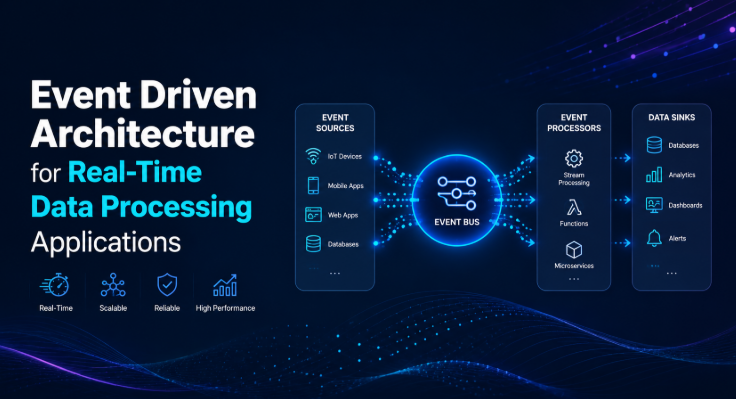
Modern applications generate and process enormous volumes of data every second. From financial transactions and online shopping to IoT devices and social media interactions, businesses need systems that can react instantly to changing conditions. Traditional request-response architectures often struggle to meet these demands, leading many organizations to adopt Event-Driven Architecture (EDA) for real-time data processing.
Event-Driven Architecture enables applications to respond immediately to events as they occur, improving scalability, responsiveness, and reliability. This guide explores the fundamentals of EDA, its components, benefits, challenges, use cases, and best practices for building efficient real-time applications.
What Is Event-Driven Architecture?
Event-Driven Architecture is a software design pattern in which system components communicate by producing and consuming events. An event represents a significant change in the state of a system, such as a customer placing an order, a payment being processed, or a sensor detecting a temperature change.
Instead of directly calling another service, an application publishes an event. Interested services subscribe to those events and respond independently, creating a loosely coupled and highly scalable system.
How Event-Driven Architecture Works
An EDA system follows a simple workflow:
- An event occurs within the application.
- The event is published to an event broker or messaging platform.
- Subscribers receive the event.
- Each subscriber processes the event independently.
- Additional events may be generated based on processing results.
This asynchronous communication enables multiple services to react simultaneously without blocking one another.
Core Components of Event-Driven Architecture
Event Producer
The producer generates events whenever an action occurs. Examples include mobile apps, IoT devices, payment systems, or web applications.
Event Broker
The event broker acts as the communication layer between producers and consumers. It routes events efficiently and ensures reliable message delivery.
Popular messaging platforms include:
- Apache Kafka
- RabbitMQ
- Apache Pulsar
- Amazon EventBridge
- Google Pub/Sub
- Azure Event Hubs
Event Consumer
Consumers subscribe to relevant events and perform tasks such as updating databases, sending notifications, processing analytics, or triggering workflows.
Event Store
Some applications maintain an event store that records every event for auditing, recovery, analytics, and event replay.
Types of Events
Business Events
Business events represent actions performed by users or business processes.
Examples include:
- Customer registration
- Order placement
- Payment confirmation
- Subscription renewal
System Events
System events originate from infrastructure or applications.
Examples include:
- Server startup
- Database update
- Application deployment
- Error detection
Sensor Events
IoT devices continuously generate sensor events.
Examples include:
- Temperature readings
- Motion detection
- GPS location updates
- Equipment status changes
Benefits of Event-Driven Architecture
Real-Time Processing
EDA enables systems to process information immediately after events occur, making it ideal for applications requiring instant responses.
High Scalability
Since producers and consumers operate independently, individual services can scale without affecting the entire application.
Loose Coupling
Services communicate through events rather than direct connections, making systems easier to modify and maintain.
Better Reliability
Message brokers can store events until consumers become available, reducing the risk of data loss during temporary failures.
Improved Flexibility
New services can subscribe to existing events without changing the original application logic.
Common Use Cases
Financial Services
Banks use EDA for fraud detection, payment processing, transaction monitoring, and real-time account notifications.
E-Commerce
Online retailers process orders, inventory updates, shipping notifications, customer recommendations, and payment confirmations using event-driven systems.
Internet of Things (IoT)
Millions of connected devices continuously publish sensor data for monitoring industrial equipment, smart homes, healthcare devices, and environmental systems.
Healthcare
Hospitals use event-driven systems to monitor patient vitals, manage medical equipment, and generate emergency alerts.
Cybersecurity
Security platforms process login attempts, network traffic, suspicious activities, and intrusion alerts in real time.
Media Streaming
Streaming platforms use EDA to manage content recommendations, user interactions, live events, and viewing analytics.
Popular Event Streaming Technologies
Several technologies support event-driven systems.
- Apache Kafka for high-throughput event streaming
- RabbitMQ for reliable message queuing
- Apache Pulsar for distributed messaging
- Amazon Kinesis for cloud-based stream processing
- Azure Event Hubs for enterprise event ingestion
- Google Pub/Sub for scalable cloud messaging
Each platform offers unique strengths depending on application requirements.
Challenges of Event-Driven Architecture
While EDA offers significant advantages, it also introduces challenges.
Increased Complexity
Managing distributed services requires careful planning, monitoring, and debugging.
Event Ordering
Ensuring events are processed in the correct sequence can be difficult in highly distributed systems.
Duplicate Events
Applications should be designed to handle duplicate event delivery safely through idempotent processing.
Monitoring and Debugging
Tracing events across multiple services requires centralized logging, distributed tracing, and observability tools.
Data Consistency
Asynchronous communication may introduce temporary inconsistencies between services until all events have been processed.
Best Practices for Implementing Event-Driven Systems
Organizations can improve the success of EDA projects by following several best practices.
Use well-defined event schemas to maintain consistency across services. Keep events small and focused on a single business action. Design consumers to handle duplicate messages safely and ensure idempotency. Implement dead-letter queues for failed messages, monitor system health continuously, secure message brokers with authentication and encryption, and use schema versioning to support future changes without disrupting existing consumers.
Event-Driven Architecture vs Traditional Architecture
| Feature | Traditional Architecture | Event-Driven Architecture |
|---|---|---|
| Communication | Synchronous | Asynchronous |
| Scalability | Moderate | High |
| Coupling | Tight | Loose |
| Response Time | Sequential | Near real time |
| Fault Tolerance | Lower | Higher |
| Flexibility | Limited | Excellent |
Future of Event-Driven Architecture
As organizations continue adopting cloud computing, artificial intelligence, edge computing, and IoT, Event-Driven Architecture will become increasingly important. Future developments are expected to include AI-powered event analysis, serverless event processing, intelligent event routing, stronger security features, and deeper integration with cloud-native platforms.
With the growth of real-time applications across industries, EDA will remain a foundational architectural pattern for building responsive, scalable, and resilient software systems.
Frequently Asked Questions (FAQs)
What is Event-Driven Architecture?
Event-Driven Architecture is a software design approach where applications communicate by producing and consuming events instead of making direct service calls.
What is an event?
An event is a record of something that has happened within a system, such as a payment, login, sensor update, or customer purchase.
Why is Event-Driven Architecture important?
It enables real-time processing, improves scalability, reduces system dependencies, and allows applications to respond quickly to changing conditions.
What is an event broker?
An event broker is middleware that receives, stores, and distributes events between producers and consumers.
Which industries benefit from EDA?
Finance, healthcare, e-commerce, manufacturing, telecommunications, transportation, logistics, cybersecurity, and IoT all benefit from event-driven systems.
Is Event-Driven Architecture suitable for microservices?
Yes. Event-Driven Architecture complements microservices by enabling loosely coupled communication between independent services.
What are the biggest challenges of EDA?
Common challenges include managing distributed systems, ensuring event ordering, handling duplicate messages, monitoring workflows, and maintaining data consistency.
How does EDA improve scalability?
Services can process events independently and scale horizontally without affecting other components, allowing systems to handle increasing workloads efficiently.
Can Event-Driven Architecture support cloud applications?
Yes. Most cloud providers offer managed event streaming and messaging services that simplify the deployment and management of event-driven applications.
Is Event-Driven Architecture the future of modern software?
Yes. As businesses increasingly require real-time insights, cloud-native scalability, and responsive digital experiences, Event-Driven Architecture is expected to play a central role in the development of modern applications.
Conclusion
Event-Driven Architecture has become a cornerstone of modern software engineering, enabling organisations to build applications that are responsive, scalable, and resilient. By using asynchronous communication through events, businesses can process data in real time, integrate distributed services efficiently, and respond quickly to changing conditions. Whether powering financial systems, e-commerce platforms, IoT networks, or cloud-native applications, EDA provides the flexibility needed to meet today’s performance demands while preparing for future technological advancements.