

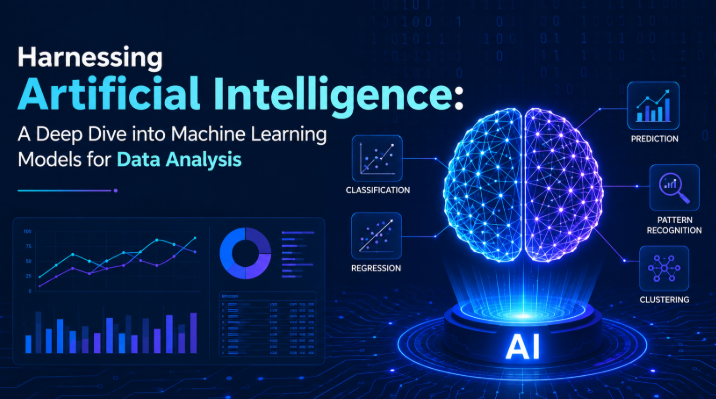
Harnessing Artificial Intelligence: A Deep Dive into Machine Learning Models for Data Analysis

admin
By admin
20 Min Read

Introduction to Artificial Intelligence and Machine Learning

Artificial Intelligence (AI) and Machine Learning (ML) are two integral concepts that are transforming various sectors, particularly data analysis. AI is a broad field that is centered around the development of systems capable of performing tasks that typically require human intelligence. These tasks include problem-solving, understanding natural language, recognizing patterns, and making decisions. AI combines diverse processes and technologies to emulate cognitive functions, adapting and improving through experience.

On the other hand, Machine Learning, as a subset of AI, specifically focuses on the creation of algorithms that allow computers to learn from and make predictions based on data. By employing statistical techniques, ML enables systems to identify patterns and insights from datasets without direct programming for every possible scenario. Machine learning algorithms are pivotal in refining the AI’s decision-making capabilities, as they are capable of adjusting their models based on new information.

The significance of AI and ML in data analysis cannot be overstated. In contemporary contexts, organizations generate vast volumes of data, and the ability to extract meaningful insights from this data is crucial for informed decision-making. Machine learning models, such as supervised and unsupervised learning, facilitate the interpretation of complex datasets by automating the process of finding correlations and trends. This efficiency allows businesses to implement data-driven strategies, optimizing operational outcomes and enhancing competitive advantage.

In summary, understanding the foundational concepts of artificial intelligence and machine learning is essential for leveraging their potential in data analysis. As organizations increasingly recognize the importance of data, the role of AI and ML will only continue to expand, offering innovative solutions to complex challenges and unlocking new avenues for growth and development.

Types of Machine Learning Models

Machine learning models can be broadly classified into three primary categories: supervised learning, unsupervised learning, and reinforcement learning. Each type serves distinct purposes and is suited for different types of data analysis tasks.

Supervised Learning is perhaps the most widely used category in machine learning. In supervised learning, the model is trained on labeled data, meaning that both the input features and the corresponding output values are provided. This type of model learns to map inputs to the correct outputs through techniques like regression and classification. Common applications include predictive analytics, spam detection, and image recognition. The key characteristic of supervised learning is that it relies heavily on the quality of labeled data for creating accurate predictive models, making it essential to use this approach when such data is available.

Unsupervised Learning, on the other hand, deals with unlabeled data. In this model, the objective is to uncover patterns, groupings, or structures within the data without prior labeling. Techniques usually employed include clustering and dimensionality reduction. Applications of unsupervised learning are diverse, ranging from market basket analysis to customer segmentation and anomaly detection. This type is particularly useful when the goal is to explore data structures and trends that do not have predefined outcomes.

Lastly, Reinforcement Learning is characterized by an agent that learns to make decisions by receiving feedback from its environment. It works through a trial-and-error approach, where the agent improves its performance based on rewards or penalties. Commonly used in robotics, gaming, and real-time decision-making applications, reinforcement learning is particularly suited for environments where information is not readily available and requires dynamic adaptation.

Data Preprocessing and Preparation for Machine Learning

Data preprocessing is a vital stage in the data analysis pipeline, particularly when it comes to training machine learning models. It encompasses a set of operations that ensure the data is clean, usable, and suitable for analysis. One of the foremost steps in this process is data cleaning, where inconsistencies, duplicates, and errors are identified and rectified. This step addresses any anomalies that might skew analysis results, thereby enhancing the reliability of machine learning outputs.

Normalization is another important aspect of data preprocessing. This technique adjusts the scale of the data, ensuring that each feature contributes equally to the model’s performance. By transforming numeric variables to a uniform scale, normalization mitigates biases that can arise from varying ranges of input data, facilitating a more accurate and efficient learning process.

Additionally, working with categorical variables often requires encoding these variables into numerical formats that machine learning algorithms can process. Techniques such as one-hot encoding or label encoding are widely used to prepare categorical data, allowing for comprehensive analysis across different data types.

Handling missing values is also critical; they can lead to incomplete data representation and can adversely affect model accuracy. Strategies such as imputation, where missing values are filled in using statistical methods, or simply removing records with missing data, can significantly enhance data quality.

Lastly, feature selection plays a key role in identifying and utilizing the most relevant variables for model training. By focusing only on the most pertinent features, one can reduce computational load and minimize the risk of overfitting, thereby improving model performance. In summary, these preprocessing steps—data cleaning, normalization, encoding, managing missing values, and feature selection—are foundational to ensuring that machine learning models yield accurate, actionable insights from data analysis.

In the field of data analysis, various machine learning algorithms serve distinct purposes, each tailored to handle specific types of challenges. Understanding these algorithms is crucial for data analysts aiming to derive insights from complex datasets. Below is a detailed overview of some widely used algorithms.

Linear Regression is one of the simplest and most commonly utilized algorithms for predicting continuous outcomes. It estimates the relationship between dependent and independent variables by fitting a linear equation to the observed data. Linear regression is particularly effective when the relationship between variables is linear, but it is limited in its ability to model complex relationships.

Decision Trees offer a clear and interpretable visualization of decision-making processes. This model partitions the dataset into subsets based on feature values, making decisions at each branch point. While decision trees are easy to understand and implement, they can be prone to overfitting, especially with deeper trees. They are best suited for classification and regression tasks where interpretability is desired.

Support Vector Machines (SVM) are powerful for classification tasks, especially in high-dimensional spaces. They work by finding the hyperplane that best separates the classes in the feature space. SVMs are effective in scenarios where there is a clear margin of separation; however, they can be computationally intensive and less effective in extreme cases of class imbalance.

Neural Networks, particularly deep learning models, have gained prominence due to their ability to model complex patterns through multiple layers of interconnected nodes. They excel in tasks like image recognition and natural language processing but require large datasets and considerable computational resources. Their opaqueness can also hinder interpretability compared to simpler models.

Each of these algorithms brings unique strengths and weaknesses to data analysis, making it essential to select the appropriate one based on the specific requirements of the task at hand.

Evaluation Metrics for Machine Learning Models

Evaluating the performance of machine learning models is a critical task in data analysis, as it determines how well a model fulfills its purpose. Various metrics are employed to measure the effectiveness of these models, allowing practitioners to understand their capabilities and limitations. The first and perhaps most straightforward metric is accuracy, which represents the ratio of correctly predicted instances to the total instances. While accuracy provides a general overview of model performance, it can be misleading, especially in cases of imbalanced datasets where one class significantly outweighs another.

In addition to accuracy, more nuanced metrics such as precision and recall are often utilized. Precision measures the proportion of true positive predictions among all positive predictions made by the model, thus focusing on the quality of the positive class predictions. On the other hand, recall indicates the proportion of true positives identified among all actual positive instances, emphasizing the model’s ability to capture relevant cases. The balance between precision and recall is often characterized by the F1 score, which is the harmonic mean of the two. This score is particularly useful when seeking to find an optimal balance between false positives and false negatives.

Another crucial evaluation tool is the ROC curve (Receiver Operating Characteristic curve) that visualizes the trade-off between sensitivity and specificity for a binary classifier as its threshold is varied. The area under the ROC curve (AUC) provides a single measure of overall model performance, with a higher AUC indicating better discrimination capability. By leveraging these metrics, data analysts can not only assess but also compare different machine learning models, guiding them toward the most effective solution for their specific problem at hand. This comprehensive evaluation process is vital for deploying robust machine learning applications in real-world scenarios.

Case Studies: Success Stories in Data Analysis using Machine Learning

Machine learning has emerged as a powerful tool across various industries, enabling organizations to analyze massive volumes of data and derive actionable insights. This section highlights several case studies that illustrate the successful implementation of machine learning models for data analysis.

One notable case is in the healthcare sector, where a prominent hospital utilized machine learning algorithms to predict patient readmissions. By applying logistic regression and decision tree models on patient data, including previous hospitalization records and chronic conditions, the hospital effectively reduced readmission rates by 20%. The predictive model allowed healthcare providers to implement targeted intervention strategies, improving patient care and reducing operational costs.

Another compelling example comes from the retail industry, where a leading company adopted machine learning to enhance customer experience and optimize inventory management. By implementing clustering algorithms on sales data, they identified purchasing patterns among customers. This analysis not only helped in tailoring marketing strategies but also allowed the firm to manage inventory levels more effectively, resulting in a 15% increase in sales within a year.

In the finance sector, a major bank employed machine learning techniques to detect fraudulent transactions. Using neural networks and ensemble methods on transaction data, the bank was able to identify unusual patterns indicative of fraud, leading to a significant decrease in financial losses. The successful deployment of these models demonstrated the effectiveness of machine learning in real-time decision-making and risk management.

Finally, in the manufacturing industry, a company used predictive maintenance powered by machine learning to minimize downtime and enhance productivity. By analyzing sensor data from machinery, they employed regression and time series forecasting models, leading to a 25% reduction in unplanned outages. This allowed for more efficient resource allocation and increased overall operational efficiency.

These case studies exemplify the vast potential of machine learning models in data analysis across different sectors, showcasing how organizations can leverage data-driven insights to solve complex problems and achieve substantial improvements.

Challenges and Limitations of Machine Learning in Data Analysis

Machine learning has revolutionized the field of data analysis, providing advanced tools for uncovering insights and patterns from large datasets. However, the deployment of machine learning models is not without its challenges and limitations. One significant issue is the phenomena of overfitting and underfitting. Overfitting occurs when a model learns the training data too well, including the noise and outliers, which results in poor performance on unseen data. Conversely, underfitting happens when a model is too simplistic to capture the underlying trends in the data, leading to inaccuracies in predictions.

Another key challenge involves biases embedded within the data itself. Data collection processes can inadvertently introduce biases, whether through unrepresentative sampling or confirmation biases in data curation. These biases can lead to skewed results, where outcomes may unfairly favor certain groups or variables while ignoring others. Addressing these biases is essential to ensure that machine learning insights are both fair and applicable to a wider population.

Interpretability is another consideration, as many machine learning algorithms function as “black boxes,” meaning that while they can generate accurate predictions, the rationale behind these predictions is often obscured. This lack of transparency can hinder trust in models, particularly in fields such as healthcare, finance, or law, where understanding the decision-making process is critical.

Finally, managing large-scale data poses logistical challenges. The volume of data generated today requires robust infrastructure and adequate processing capabilities to train machine learning models effectively. Additionally, large datasets can sometimes lead to increased complexity, making it difficult to draw straightforward conclusions.

Recognizing these challenges is crucial for practitioners looking to implement machine learning successfully in data analysis.

As we look ahead to the future of machine learning and data analysis, several significant trends are poised to shape the landscape of this rapidly evolving field. One of the most notable developments is the increasing reliance on deep learning models, which are distinguished by their ability to process vast amounts of data with high accuracy. These models leverage neural network architectures that enable machines to learn complex patterns and features from unstructured data, making them particularly effective in fields such as image recognition, natural language processing, and more.

Furthermore, the advancement of Automated Machine Learning (AutoML) is expected to transform the accessibility of machine learning techniques for a broader audience. AutoML platforms are designed to automate end-to-end processes of applying machine learning to real-world problems, thereby reducing the need for extensive domain expertise. This trend not only democratizes data analysis but also allows organizations to rapidly deploy scalable solutions without the complexities traditionally associated with model design and tuning.

The intersection of big data and machine learning is another emerging trend that cannot be overlooked. The proliferation of large datasets has fueled the development of innovative modeling techniques that can efficiently handle voluminous inputs. As organizations continue to generate and acquire massive amounts of data, machine learning models will increasingly be optimized to analyze this information in real-time, leading to faster and more informed decision-making.

Additionally, the integration of artificial intelligence with other cutting-edge technologies, such as the Internet of Things (IoT) and blockchain, is likely to yield groundbreaking applications in data analysis. By combining machine learning capabilities with these technologies, organizations can enhance data security, improve operational efficiency, and create new value propositions. This synergy underscores a pivotal shift towards a more interconnected and intelligent data ecosystem, paving the way for innovative approaches to problem-solving across various sectors.

Conclusion and Key Takeaways

As we conclude our exploration of machine learning models for data analysis, it is evident that these technologies hold transformative potential across various industries. The application of artificial intelligence enables organizations to process vast amounts of data more effectively, uncovering valuable insights that were once hidden amidst the noise. The key takeaway is the ability of machine learning models to automate routine tasks while enhancing decision-making processes through predictive analytics.

Furthermore, the adaptability of these models allows for continual improvement over time as they are exposed to more data. It is essential to highlight that while the benefits are substantial, there are significant challenges that need to be considered. Issues such as data quality, bias, and the ethical implications of AI systems require careful attention from practitioners and researchers alike.

Moreover, embracing machine learning models necessitates a commitment to lifelong learning. The field of artificial intelligence is constantly evolving, with new algorithms and techniques being developed regularly. For individuals and organizations looking to harness the power of AI, keeping abreast of the latest advancements in technology is crucial. This commitment not only involves technical skills but also an understanding of how these tools can impact strategic planning and operational efficiency.

In summary, the advent of machine learning models represents a significant shift in how we approach data analysis. By recognizing their transformative potential while also being aware of the challenges they present, stakeholders can better navigate the complexities of this rapidly changing landscape. The journey into machine learning is just beginning, and those who engage with it proactively will likely reap the most rewards in the future.

TAGGED:
Share This Article
Leave a comment

Leave a Reply

Your email address will not be published. Required fields are marked *