


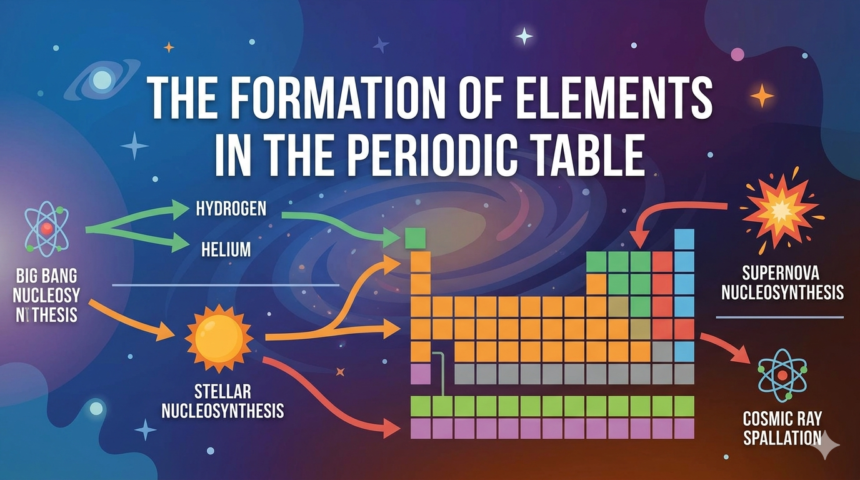
The elements in the periodic table are the building blocks of everything in the universe. Every object, from the air we breathe and the water we drink to the stars in distant galaxies, is made of chemical elements. But where did these elements come from? Scientists have discovered that elements were formed over billions of years through a series of remarkable cosmic events, beginning with the Big Bang and continuing inside stars, exploding supernovae, and even neutron star collisions.
Understanding how elements formed helps us learn about the history of the universe, the life cycle of stars, and the origins of the matter that makes up our planet and ourselves.
What Is the Periodic Table?
The periodic table is a chart that organizes all known chemical elements according to their atomic number, electron configuration, and chemical properties.
Each element contains a unique number of protons in its nucleus. Today, the periodic table contains 118 confirmed elements, ranging from hydrogen, the lightest element, to oganesson, one of the heaviest known elements.
The table groups elements with similar chemical characteristics, making it an essential tool in chemistry, physics, and materials science.

The Birth of the First Elements
The story of the elements begins with the Big Bang, which occurred approximately 13.8 billion years ago.
In the first few minutes after the Big Bang, the universe was extremely hot and dense. As it expanded and cooled, protons and neutrons combined to form the first atomic nuclei.
This process, known as Big Bang nucleosynthesis, produced mainly:
- Hydrogen
- Helium
- Small amounts of lithium
These were the first elements to exist in the universe.
How Stars Create New Elements
After the first stars formed, they became enormous nuclear reactors.
Inside a star’s core, intense pressure and temperatures cause nuclear fusion, where lighter elements combine to create heavier ones.
During their lifetime, stars produce elements such as:
- Carbon
- Nitrogen
- Oxygen
- Neon
- Magnesium
- Silicon
These elements are essential for planets and life.
Nuclear Fusion Explained
Nuclear fusion occurs when atomic nuclei combine to form a heavier nucleus while releasing enormous amounts of energy.
For example, hydrogen atoms fuse into helium within the Sun. As stars age, they begin fusing progressively heavier elements.
Fusion powers stars and is responsible for producing many of the elements found throughout the universe.
The Creation of Heavy Elements
Stars cannot continue fusion indefinitely.
When massive stars exhaust their fuel, they eventually produce iron in their cores. Since iron fusion does not release energy efficiently, the star can no longer support itself against gravity.
This leads to a dramatic collapse followed by a powerful supernova explosion.
During these explosions, enormous amounts of energy create many elements heavier than iron.
Supernova Explosions
Supernovae are among the most energetic events in the universe.
These explosions create and scatter elements such as:
- Gold
- Silver
- Uranium
- Platinum
- Lead
- Nickel
The explosion spreads these newly formed elements across space, enriching clouds of gas and dust that later form new stars and planets.
Without supernovae, many of the elements found on Earth would not exist.
Neutron Star Collisions
Recent astronomical observations have shown that neutron star mergers are another major source of heavy elements.
When two neutron stars collide, they release enormous numbers of neutrons that rapidly build heavy atomic nuclei through a process called the rapid neutron-capture process (r-process).
Many precious metals, including gold and platinum, are thought to originate from these extraordinary cosmic events.
Formation of Elements on Earth
The Earth formed about 4.5 billion years ago from gas and dust left behind by earlier generations of stars.
As the young planet cooled, elements combined to form minerals, rocks, oceans, and eventually living organisms.
Every atom in our bodies was originally created inside ancient stars or during powerful cosmic explosions.
Synthetic Elements
Not all elements occur naturally.
Scientists have created several heavy elements in laboratories using powerful particle accelerators.
Examples include:
- Nihonium
- Moscovium
- Tennessine
- Oganesson
These synthetic elements are generally unstable and exist only for extremely short periods before decaying into lighter elements.
Why the Periodic Table Matters
The periodic table is more than a list of elements.
It helps scientists:
- Predict chemical behaviour
- Understand atomic structure
- Develop new materials
- Advance medicine
- Improve electronics
- Explore space science
Its organization has made it one of the most important scientific tools ever developed.
Elements and Everyday Life
Chemical elements play a role in nearly every aspect of modern life.
Examples include:
- Oxygen for breathing
- Iron for construction
- Silicon for computer chips
- Copper for electrical wiring
- Calcium for healthy bones
- Carbon for all known life
Every industry depends on the unique properties of different elements.
The Future of Element Research
Scientists continue searching for new superheavy elements beyond those currently listed in the periodic table.
Researchers are also studying how elements behave under extreme conditions and exploring whether an “island of stability” may exist, where certain superheavy elements could survive much longer than expected.
Future discoveries may expand our understanding of nuclear physics and the structure of matter itself.
Conclusion
The formation of elements is one of the greatest stories in science. Beginning with the Big Bang, continuing through the life and death of stars, and extending to powerful neutron star collisions, the universe has spent billions of years creating the elements that make up everything around us.
The periodic table reflects this remarkable history, organizing the building blocks of matter in a way that helps scientists understand chemistry, physics, astronomy, and the origins of life. As research continues, our knowledge of how elements form and interact will continue to shape scientific discovery and technological innovation.
Frequently Asked Questions (FAQs)
1. How were the first elements formed?
The first elements—primarily hydrogen and helium, along with small amounts of lithium—formed within the first few minutes after the Big Bang through a process called Big Bang nucleosynthesis.
2. How do stars create new elements?
Stars produce new elements through nuclear fusion, where lighter elements combine under extreme temperatures and pressure to form heavier elements such as carbon, oxygen, and silicon.
3. Where do elements heavier than iron come from?
Most elements heavier than iron are formed during supernova explosions and neutron star collisions, where extreme conditions allow rapid neutron capture to build heavy atomic nuclei.
4. Are all elements found naturally?
No. While many elements occur naturally, several heavy elements have been created artificially in laboratories using particle accelerators.
5. Why is the periodic table important?
The periodic table organizes elements based on their atomic structure and chemical properties, helping scientists predict behaviour, conduct research, and develop new technologies.
6. Are humans made from elements formed in stars?
Yes. The elements that make up the human body—including carbon, oxygen, nitrogen, calcium, and iron—were created in ancient stars and dispersed throughout the universe before the formation of Earth.