

Introduction to the Periodic Table
The periodic table serves as one of the most significant tools in the field of chemistry, where it provides a comprehensive framework for understanding the properties and relationships of the chemical elements. By organizing elements based on their atomic number and electron configuration, the periodic table facilitates knowledge about the trends in elemental behavior, such as reactivity, electronegativity, and ionization energy. This systematic arrangement not only enhances our grasp of the elements but also paves the way for discovering new materials and compounds.
The historical progression towards the modern periodic table is equally fascinating, beginning in the early 19th century. Dmitri Mendeleev, a Russian chemist, is credited with creating the first widely accepted periodic table in 1869. Mendeleev arranged elements in order of increasing atomic weight, recognizing that their chemical properties exhibited periodic trends. His innovative approach enabled him to predict the existence and properties of yet undiscovered elements, demonstrating the table’s utility and insight.
Further developments followed as scientists like Henry Moseley refined the periodic table by introducing the concept of atomic number as the organizing principle. This shift from atomic weight to atomic number provided a more accurate representation of elemental relationships and properties, ultimately leading to the modern periodic table that we utilize today. Each column, or group, corresponds to elements with similar properties, while each row, or period, signifies elements with incrementally higher atomic numbers. The redefined structure has since become fundamental for chemists and educators alike, facilitating a clearer understanding of elemental interactions within various scientific fields.
Understanding Atomic Structure
The basic structure of an atom is fundamental to understanding the formation of elements as outlined in the periodic table. Atoms are composed of three primary subatomic particles: protons, neutrons, and electrons. Protons, which carry a positive electric charge, are located in the nucleus at the center of the atom. Their number defines the atomic number of an element, thereby identifying which element it is. Neutrons, which have no electric charge, are also found in the nucleus and contribute to the atomic mass but do not change the element’s identity. Together, protons and neutrons form the nucleus, which is surrounded by a cloud of electrons.
Electrons, carrying a negative charge, are arranged in energy levels or shells around the nucleus. The number of electrons in an atom equals the number of protons, ensuring that the overall charge of the atom is neutral. The arrangement of these electrons determines the chemical properties of the element, influencing how it interacts with other atoms. For instance, elements that have a full outer shell of electrons, like the noble gases, are typically unreactive, while those with nearly full or nearly empty outer shells are more inclined to engage in chemical bonding.
The variation in the number of protons, neutrons, and electrons across different atoms results in the diverse range of elements in the periodic table. This diversity is critical in forming chemical compounds and understanding fundamental chemical reactions. As such, the atomic structure not only reveals the identity of an element but also provides insights into its behavior and properties. In summary, the arrangement and number of subatomic particles within an atom are essential factors in the formation of elements, influencing their unique characteristics and their place in the periodic table.
Nuclear Fusion in Stars
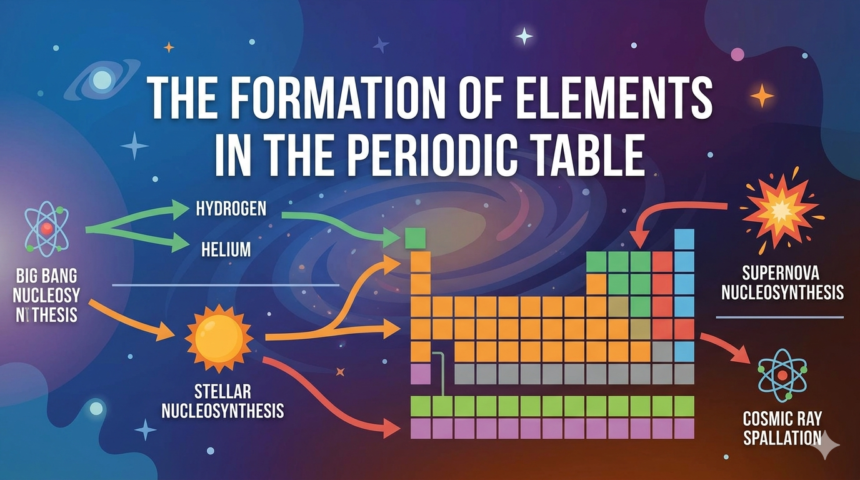
Nuclear fusion is a fundamental process that occurs in the cores of stars, leading to the formation of new elements. This reaction involves the merging of lighter atomic nuclei to form a heavier nucleus, releasing a significant amount of energy in the process. The primary conditions required for nuclear fusion include extremely high temperatures, typically above ten million degrees Celsius, and immense pressure, which is achieved by the gravitational forces exerted in the core of a star.
As the core temperature rises, hydrogen nuclei (protons) gain sufficient kinetic energy to overcome their electrostatic repulsion. They collide and fuse together, primarily through a process known as the proton-proton chain reaction or the CNO cycle, depending on the star’s mass. In less massive stars like our Sun, hydrogen fuses into helium via the proton-proton chain. In contrast, in more massive stars, the carbon-nitrogen-oxygen (CNO) cycle is the dominant fusion process. This leads to a steady accumulation of helium in the core as hydrogen is consumed.
As the hydrogen supply gets depleted, the core’s temperature continues to rise, allowing helium to undergo fusion into even heavier elements, such as carbon and oxygen. In massive stars, this process can progress even further; they can fuse carbon into heavier elements like neon, magnesium, and ultimately iron during their lifecycle. Each stage of fusion generates varying elements, contributing to the cosmic abundance of these substances, which are critical for planet formation and the chemistry necessary for life. The fusion process ceases when a star produces iron since it is the most stable element and cannot efficiently release energy through further fusion. Consequently, when stars exhaust their fuel, they may collapse under their own gravity, leading to supernova explosions, dispersing newly formed elements into space, enriching the universe with a variety of elements essential for subsequent cosmic development.
Supernova Explosions and Element Formation
Supernova explosions represent one of the most fascinating and crucial processes in the cosmos, playing a pivotal role in the formation of heavier elements in the universe. These cataclysmic events occur at the end of the lifecycle of massive stars, which typically exceed eight times the mass of our Sun. Throughout their existence, these stars produce energy through nuclear fusion, converting hydrogen into helium, and subsequently fusing heavier elements like carbon, oxygen, and silicon in their cores. As the star exhausts its nuclear fuel, it can no longer sustain the outward pressure generated by fusion against gravitational collapse.
Once the core contracts under its immense gravity, temperatures escalate to dramatically high levels, enabling the fusion of even heavier elements, such as iron and nickel. This stage of element production involves complex nuclear processes, resulting in an array of elements from lithium to elements heavier than iron. When the core becomes predominantly iron, fusion ceases to produce energy, leading to catastrophic core collapse.
The subsequent supernova explosion signifies a violent release of energy and matter into space, dispersing newly formed elements across the universe. This dynamic event ejects luminous shells of gas, rich in elements created during the nucleosynthesis processes. The combination of shock waves generated during the explosion and the high temperatures facilitates the synthesis of even heavier elements, like gold and uranium, through rapid neutron capture processes. This remarkable cycle of life, death, and rebirth sets the stage for the creation of heavier elements, contributing significantly to the chemical diversity of the cosmos.
Through supernova explosions, the elements formed in the lifecycle of massive stars play an essential role in enriching the interstellar medium. Hence, understanding supernovae provides deep insights into the origins of elements that constitute stars, planets, and ultimately, life as we know it.
The Role of Neutron Capture
Neutron capture is a fundamental process in nuclear astrophysics that contributes significantly to the formation of elements in the universe. It occurs when atomic nuclei absorb free neutrons, leading to the creation of heavier isotopes and elements. This process can take place in various astrophysical environments, such as during supernova explosions or within the interiors of stars, thus playing a crucial role in nucleosynthesis.
There are primarily two mechanisms of neutron capture: the s-process and the r-process. The s-process, or slow neutron capture process, occurs at relatively low neutron flux and takes place in asymptotic giant branch (AGB) stars. In this process, atomic nuclei capture neutrons slowly compared to their beta decay rates. This allows for a series of beta decays to take place, resulting in the formation of stable isotopes and a range of heavy elements, including lead and bismuth. The abundance of these elements in the universe can largely be attributed to the s-process, which operates over extended periods within these stars.
In contrast, the r-process, or rapid neutron capture process, occurs under conditions of extreme neutron flux, such as during supernovae or neutron star mergers. In this case, atomic nuclei capture neutrons at a much faster rate than they can undergo beta decay. The r-process leads to the formation of very heavy and often unstable isotopes, which eventually decay into stable elements. This rapid capture mechanism is responsible for producing many of the heavy elements found in our periodic table, such as gold and platinum, highlighting its significance in cosmic element formation.
Both the s-process and r-process underscore the intricacy of nucleosynthesis, revealing how neutron capture contributes to the diversity of elemental isotopes and the overall composition of the universe.
Cosmic Microwave Background Radiation and Elemental Formation
The Cosmic Microwave Background Radiation (CMB) serves as a pivotal remnant of the early universe, providing vital clues about its initial conditions and the processes that led to elemental formation. Initially, when the universe was merely a hot, dense soup of particles approximately 380,000 years after the Big Bang, photons could not travel freely due to the scattering with charged particles. As the universe expanded and cooled, it reached a stage known as recombination, where electrons teamed up with protons to form neutral hydrogen, allowing photons to decouple and stream freely. This released what we now observe as the CMB, a faint glow permeating the universe, representing one of the earliest snapshots of cosmic evolution.
The significance of CMB in understanding elemental formation lies in its uniformity and minute fluctuations, which reflect the density variations in the primordial plasma. These fluctuations acted as seeds for the subsequent formation of large-scale structures, like galaxies. More importantly, during the first few minutes of the universe, a process called Big Bang nucleosynthesis occurred, where temperatures and densities were sufficient to facilitate nuclear reactions. As protons and neutrons combined through fusion, light elements such as hydrogen, helium, and traces of lithium were formed, which constitute about 75% and 25% of the universe’s baryonic matter, respectively.
The CMB also provides critical evidence supporting the predictions of Big Bang nucleosynthesis. When astronomers analyze the relative abundances of these light elements against the background radiation, they find a concordance between observed ratios and theoretical expectations. Thus, the significance of CMB transcends mere cosmic history; it envelops a comprehensive understanding of the elemental composition originating from the universe’s formation. This knowledge continues to serve as a cornerstone in the fields of cosmology and astrophysics, bolstering the framework of our universe’s formative moments.
From Fusion and Fission to the Periodic Table
The formation of elements, as represented in the periodic table, is intricately linked to the processes of nuclear fusion and fission. These nuclear reactions, while operating on fundamentally different principles, play critical roles in the synthesis and categorization of elements found in the periodic table.
Nuclear fusion occurs when two light atomic nuclei combine to form a heavier nucleus, releasing a tremendous amount of energy in the process. This is the primary mechanism that powers stars, including our sun. In the core of stars, hydrogen atoms fuse to create helium and, under extreme temperatures and pressures, continue to undergo further fusion to create heavier elements such as carbon, oxygen, and even iron. These fusion processes establish the first groups of elements as they form the foundational building blocks of matter, many of which are categorized as non-metals and metalloids in the periodic table.
Conversely, nuclear fission involves the splitting of a heavy atomic nucleus into lighter nuclei, along with the release of energy. This reaction encompasses elements such as uranium and plutonium, which are integral to nuclear energy production. The fission process is more commonly associated with elements towards the bottom of the periodic table, particularly in the actinide series. This pertaining group illustrates how elements can be induced to split and create lighter elements while releasing significant energy, impacting how we categorize and utilize these elements.
Through these mechanisms, fusion contributes to element creation in stars, while fission plays a pivotal role in energy generation and specific applications in nuclear technology. Together, understanding these two processes enriches our comprehension of the periodic table and underscores the dynamic nature of elemental formation.
Applications of the Periodic Table in Science and Industry
The periodic table serves as a fundamental tool in both scientific research and various industrial applications. As a comprehensive representation of chemical elements, the periodic table facilitates the understanding of material properties, atomic structure, and the ways in which different elements interact. These principles are vital across numerous disciplines, including chemistry, physics, biology, and engineering.
In technology, many elements from the periodic table are integral to the development of electronic devices. For instance, silicon is a key component in semiconductors, forming the backbone of most electronic circuits and computers. Its ability to efficiently conduct electricity makes it essential for modern technology. Similarly, rare earth elements such as neodymium are used in powerful magnets for electric motors and generators, further demonstrating the periodic table’s impact on technological advancement.
Medicine also heavily relies on the periodic table. Elements such as iodine are crucial in medical imaging and antiseptics; they possess properties that make them effective in diagnostics and treatments. Furthermore, radioactive isotopes like technetium-99m are pivotal in nuclear medicine, allowing for advanced imaging techniques that aid in disease detection and management.
Industrially, elements like iron and aluminum are indispensable in construction and manufacturing. The properties of these metals, including strength and resistance to corrosion, are well-documented in the context of their applications. Copper, another notable element, is extensively used in electrical wiring due to its excellent conductivity. Thus, various industries leverage insights derived from the periodic table to enhance processes and develop new materials.
Overall, the applications of elements from the periodic table extend far beyond theoretical concepts; they are fundamental to our daily lives and the advancement of society. Their practical uses underscore the significance of the periodic table in modern science and industry.
Conclusion: The Ongoing Journey of Element Discovery
The formation of elements, as detailed throughout the previous sections, highlights the intricate processes that govern their creation in stellar environments and their subsequent distribution throughout the universe. Each of the elements that constitute the periodic table has its unique origin story, primarily arising from the fusion processes occurring within stars, supernovae explosions, and neutron star collisions. Understanding these processes not only enriches our comprehension of the elements themselves but also unveils the dynamic nature of the cosmos.
Moreover, as science progresses, the boundaries of our knowledge regarding these fundamental components are continuously expanded. Studies in nuclear physics, astrophysics, and advanced materials science contribute significantly to our understanding of how elements behave under various conditions. The discovery of new synthetic elements, alongside the investigation of their properties, paves the way for potential applications that can impact various fields, including medicine and technology. This emphasizes the importance of continued research in the field of elemental formation and behavior.
The periodic table is a living document, reflecting the evolving understanding of chemistry and the universe. Scientists remain dedicated to uncovering not just new elements but also insights into their interactions and potential uses. This ongoing journey of element discovery reveals the complexities of the atomic world and its profound implications for both fundamental and applied sciences. The future will invariably unfold new chapters in the story of elements, highlighting their significance in shaping both our material reality and our understanding of the universe.