

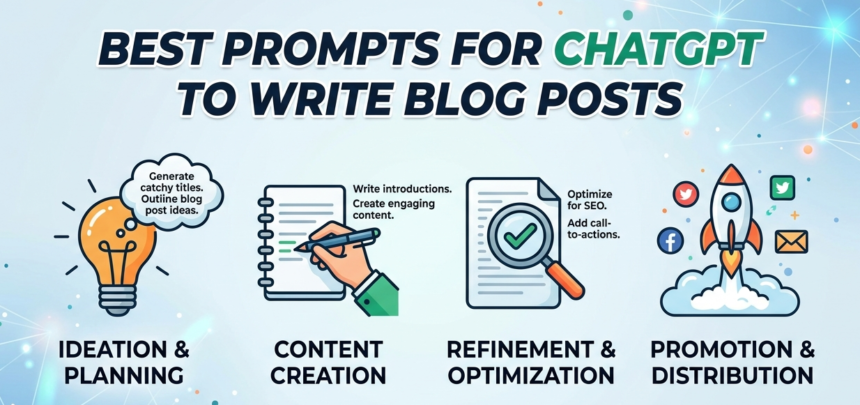
Artificial intelligence has transformed content creation, and ChatGPT has become one of the most popular tools for bloggers, marketers, businesses, and freelance writers. Instead of spending hours brainstorming ideas or struggling with writer’s block, users can generate blog outlines, introductions, SEO-friendly articles, and engaging conclusions within minutes.
However, the quality of AI-generated content depends largely on the prompts you provide. A well-written prompt gives ChatGPT clear instructions about the topic, audience, tone, structure, and desired outcome. This guide explores some of the best prompts you can use to create high-quality blog posts more efficiently.
What Is a ChatGPT Prompt?
A prompt is the instruction or question you give to ChatGPT.
It tells the AI what you want to create and how the final content should be structured. The more specific your prompt, the more relevant and useful the response is likely to be.
A detailed prompt helps reduce unnecessary revisions and produces content that better matches your goals.
Why Good Prompts Matter
Strong prompts improve both the quality and consistency of AI-generated writing.
Benefits include:
- Better content structure
- More accurate information
- Improved readability
- Stronger SEO optimization
- Reduced editing time
- More engaging writing
Clear instructions allow ChatGPT to better understand your expectations.
Prompt for a Complete Blog Article
Use this prompt when you need a full-length article.
Example Prompt:
“Write a 2,000-word SEO-optimized blog post about [topic]. Include an engaging introduction, clear H2 and H3 headings, practical examples, a conclusion, and six frequently asked questions. Write in a professional, human-friendly tone with minimal bullet points.”
This prompt works well for educational, business, health, technology, and lifestyle topics.
Prompt for SEO Optimization
If search engine visibility is your goal, use a dedicated SEO prompt.
Example Prompt:
“Write an SEO-friendly article targeting the keyword ‘[primary keyword]‘. Naturally include related keywords, optimize headings, create a compelling introduction, and write a meta title and meta description at the end.”
This helps produce content that is easier to optimize for search engines.
Prompt for Creating an Outline
An outline provides structure before writing the full article.
Example Prompt:
“Create a detailed blog outline for the topic ‘[topic]‘. Include an introduction, H2 headings, H3 subheadings, conclusion, and FAQ section.”
Reviewing an outline first can improve organization and save editing time.
Prompt for Writing an Introduction
An engaging introduction encourages readers to continue reading.
Example Prompt:
“Write a compelling introduction for a blog post about ‘[topic]‘. Make it informative, engaging, and optimized for both readers and search engines.”
A strong introduction should explain why the topic matters and what readers will learn.
Prompt for Expanding Existing Content
You can use ChatGPT to improve shorter articles.
Example Prompt:
“Expand this blog post to approximately 2,000 words while maintaining a natural writing style. Add useful examples, practical tips, updated information, and an FAQ section without repeating content.”
This is helpful when refreshing older blog posts.
Prompt for Writing FAQs
Frequently Asked Questions improve user experience and may support search visibility.
Example Prompt:
“Generate six informative FAQs with concise answers for a blog article about ‘[topic]‘. Focus on common questions readers are likely to ask.”
Well-written FAQs address reader concerns and provide additional value.
Prompt for Simplifying Complex Topics
Some subjects require simpler explanations.
Example Prompt:
“Explain ‘[topic]‘ in simple language suitable for beginners. Use clear examples, avoid unnecessary technical terms, and maintain an educational tone.”
This prompt is ideal for technology, finance, healthcare, and science topics.
Prompt for Improving Readability
After generating a draft, improve its flow and clarity.
Example Prompt:
“Rewrite this article to improve readability, sentence flow, grammar, and engagement while preserving the original meaning. Use short paragraphs, natural transitions, and a conversational yet professional tone.”
Editing prompts often produce more polished content.
Prompt for Creating Catchy Titles
Titles influence whether readers click on your content.
Example Prompt:
“Generate 15 SEO-friendly blog titles for the keyword ‘[keyword]‘. Keep each title engaging, under 60 characters where possible, and optimized for search engines.”
Testing different title options can improve click-through rates.
Best Practices for Writing AI Prompts
Well-crafted prompts consistently produce better results.
Consider these tips:
- Be specific about the topic.
- Mention your target audience.
- Specify the desired tone.
- Include word count requirements.
- Request a clear heading structure.
- Mention SEO requirements if needed.
The more context you provide, the more useful the output is likely to be.
Common Mistakes to Avoid
Many users receive poor results because their prompts are too vague.
Avoid:
- Very short instructions
- Missing target audience information
- Forgetting SEO requirements
- Omitting formatting instructions
- Requesting unrealistic amounts of information in one prompt
Clear instructions generally produce higher-quality articles.
The Future of AI Writing Prompts
As AI continues to improve, prompts are becoming more sophisticated.
Future AI systems may better understand user intent, writing style, brand voice, and content objectives with fewer instructions. Even so, carefully written prompts will remain important for producing accurate, engaging, and high-quality content.
Learning prompt-writing skills will continue to be valuable for content creators.
Conclusion
ChatGPT is a powerful writing assistant, but the quality of its output depends heavily on the prompts it receives. By using clear, detailed instructions that specify your topic, audience, tone, structure, and SEO goals, you can create blog posts that are informative, engaging, and easier to optimize for search engines.
Whether you’re writing educational articles, business content, technology guides, or lifestyle blogs, mastering prompt writing can save time, improve consistency, and help you produce better content more efficiently.
Frequently Asked Questions (FAQs)
1. What is a ChatGPT prompt?
A prompt is the instruction or request you provide to ChatGPT to generate text, answer questions, or complete a specific writing task.
2. Why are detailed prompts better?
Detailed prompts provide more context, helping ChatGPT generate content that is more accurate, organized, and aligned with your goals.
3. Can ChatGPT write SEO-friendly blog posts?
Yes. When given appropriate instructions, ChatGPT can create SEO-friendly articles with optimized headings, keywords, FAQs, and meta descriptions.
4. Should I edit AI-generated blog posts?
Yes. Reviewing and editing AI-generated content helps improve accuracy, originality, readability, and alignment with your brand voice.
5. Can ChatGPT generate blog outlines?
Yes. ChatGPT can create structured outlines that include introductions, headings, subheadings, conclusions, and FAQ sections.
6. What makes a good AI writing prompt?
A good prompt clearly defines the topic, target audience, desired tone, formatting, word count, SEO requirements, and any additional instructions needed to produce high-quality content.